
Blog
Donating Art to a Kentucky Museum? The Qualified Appraisal the IRS Requires
Donating art to the Speed Art Museum, the University of Kentucky, or U of L's Hite Institute can earn a real tax deduction, but only with a qualified appraisal that meets IRS thresholds, timing rules, and Form 8283 requirements. This guide walks through exactly what Kentucky donors need before the gift, and what the appraisal must say.
Donating a painting, print, or sculpture to a Kentucky institution can generate a genuine income tax deduction, but the IRS treats art differently from cash gifts or even most other types of property. Claim a deduction over $5,000 and a qualified appraisal becomes mandatory. Claim $20,000 or more and the full signed appraisal has to travel with your tax return. Our team of Kentucky fine art appraisers works with donors across the state, and this guide covers what the Speed Art Museum in Louisville, the Art Museum at the University of Kentucky, and the University of Louisville's Hite Institute of Art + Design each expect before accepting a gift, along with what the IRS demands from the appraisal behind it.
Kentucky Museums Review Gifts Before They Accept Them
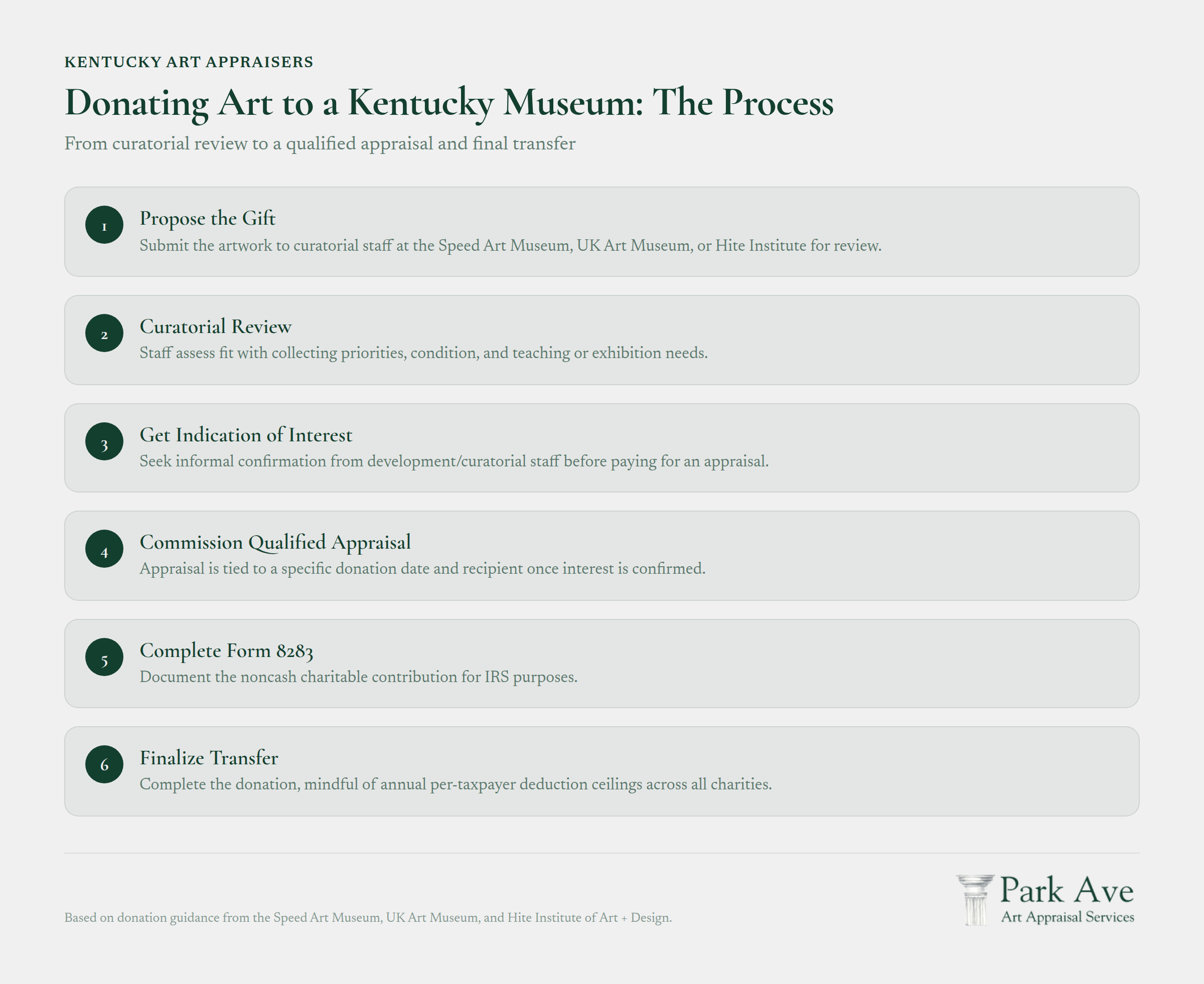
None of Kentucky's major art institutions take a donation sight unseen. Each routes proposed gifts through curatorial staff first, who evaluate the work against the museum's collecting priorities, its condition, and whether it genuinely fits the collection before agreeing to accept it.
- The Speed Art Museum (Louisville) reviews proposed gifts through its curatorial department, which considers how a piece fits the museum's existing holdings and collecting focus before recommending acceptance.
- The Art Museum at the University of Kentucky (Lexington) evaluates donated works through its curatorial and academic staff, since pieces often support teaching collections as well as public exhibition.
- The Hite Institute of Art + Design at the University of Louisville weighs proposed gifts against its teaching and exhibition needs, again through curatorial review rather than automatic acceptance.
This matters for the appraisal timeline. Donors sometimes commission an appraisal before a museum has agreed to take the piece, only to have the gift declined or redirected to a different recipient. It's worth getting at least an informal indication of interest from the museum's development or curatorial office before paying for a full qualified appraisal, since the appraisal itself is tied to a specific donation date and a specific recipient.
The Speed Art Museum's own donation guidance also reminds prospective donors that federal deduction limits stack on top of the appraisal rules. As the museum notes, gifts to all charities combined cannot exceed a set dollar ceiling per taxpayer each year, a separate constraint from the appraisal thresholds discussed below.
The $5,000 Threshold That Triggers a Qualified Appraisal
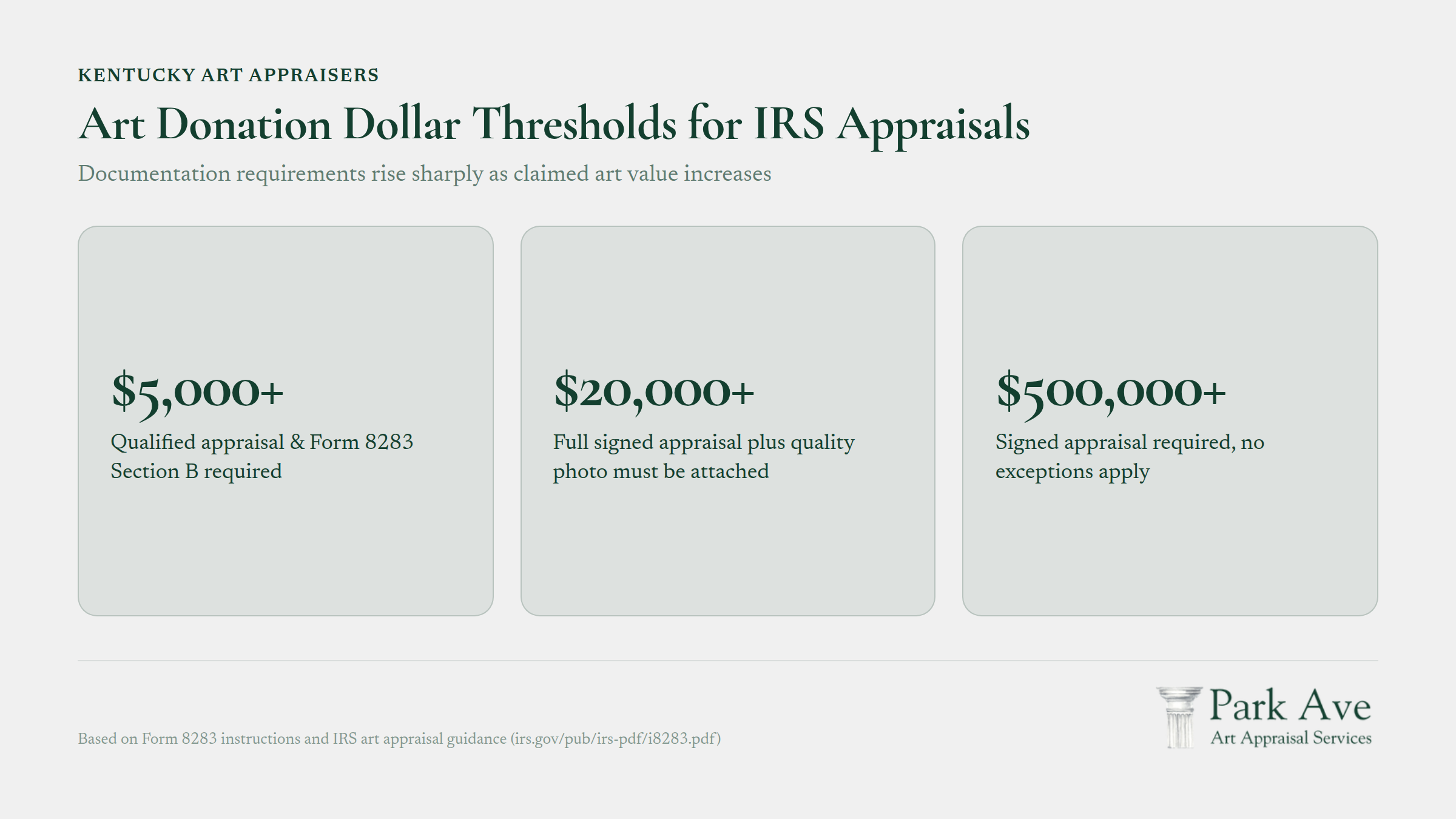
A claimed deduction over $5,000 for donated art requires a qualified appraisal and Form 8283, Section B. This is the single most important number in the entire process, and it applies whether the gift is a single painting or a group of similar items donated to one or more institutions during the year.
Once you cross $5,000, the IRS wants more than a receipt or a gallery invoice. IRS Publication 561 and the Form 8283 instructions require a qualified appraisal prepared by a qualified appraiser, along with a completed Section B that identifies the property, the date and manner of acquisition, the appraiser's qualifications, and the appraised fair market value. Below $5,000, a donor generally only needs Section A of Form 8283 and can rely on records rather than a formal appraisal.
Example: A donor gives a print appraised at $6,500 to the Hite Institute. Because the deduction exceeds $5,000, the donor needs a qualified appraisal and must complete Section B of Form 8283, even though the museum's own gift-acceptance paperwork is separate from the IRS filing.
Watch out: For deductions between $5,000 and $20,000, the appraisal itself does not have to be attached to the return, but it must be kept in the donor's records. Attaching a copy anyway is a common practice among CPAs, since it reduces the odds the return gets flagged for review.
The $20,000 Threshold: Attaching the Full Appraisal and a Photograph
For a claimed art deduction of $20,000 or more, the complete signed appraisal must be attached to the tax return, not just the summary information on Form 8283. This is a higher bar than the general $5,000 rule, and it applies specifically to art rather than to donated property generally.
At this level, the IRS also expects a quality photograph of the piece large enough to show the object clearly, and the agency has recommended a professional-quality image for higher-value donations. The Form 8283 instructions and the IRS's art appraisal guidance both reflect this heightened documentation standard, and for gifts of art or similar property exceeding $500,000, a signed copy of the appraisal must be attached regardless of any other exception.
Pro tip: If your collection includes several related items, such as a set of prints by the same artist, the IRS aggregates similar items when testing these thresholds. A donor who gives four prints worth $6,000 apiece in the same year is treated as making a $24,000 donation of similar property for purposes of the $20,000 rule, not four separate $6,000 gifts.
When the Qualified Appraisal Must Be Completed
A qualified appraisal must be dated no earlier than 60 days before the date of the donation and no later than the due date, including extensions, of the return on which the deduction is first claimed. Miss either end of that window and the appraisal doesn't qualify, no matter how thorough it is.
This timing rule comes from the Treasury regulations governing charitable contribution substantiation, which set out the appraisal window alongside the qualifications an appraiser must hold and the specific content the report must contain (see 26 CFR 1.170A-13). In practice, this means donors should schedule the appraisal close to, but before, the transfer date once a museum has indicated it will accept the gift. Waiting until tax season the following spring, when the piece changed hands ten months earlier, risks falling outside the 60-day window on the front end.
Key takeaway: The appraisal date, the donation date, and the tax return filing date all have to line up correctly. Getting the sequence wrong is one of the most common (and entirely avoidable) reasons a deduction gets challenged.
The Related-Use Rule and the Three-Year Recapture Risk
Under the related-use rule, a donor of tangible personal property like art can only deduct full fair market value if the museum's use of the work is related to its exempt purpose, such as display, study, or teaching. A museum accepting a painting for its permanent collection or a university accepting a sculpture for its teaching galleries satisfies this rule easily, which is one reason curatorial review matters before the gift is finalized.
The risk shows up later. If the recipient institution disposes of the donated item within three years of the gift, without certifying that the use remained related to its exempt purpose or that the related use became impossible, the museum is required to report that disposition to the IRS, and the donor's deduction can be recaptured. The Form 8283 instructions describe the donee's certification obligations that tie into this reporting requirement, which flows through IRS Form 8282 when a covered item is sold, exchanged, or otherwise disposed of within the three-year window.
Example: A collector donates a $30,000 painting to the Art Museum at the University of Kentucky for its permanent collection. Eighteen months later, the museum deaccessions the piece and sells it at auction without certifying that related use had become impossible. That sale can trigger a Form 8282 filing and put the donor's original deduction at risk of recapture.
Kentucky's Separate Rule for Self-Created Artistic Works
Kentucky law provides an additional, narrower deduction under KRS 141.0201 for a "qualified artistic charitable contribution." This provision applies only when the donor is the artist who created the work, the piece was completed at least one year before the donation, the donor obtains a written appraisal within one year of the gift, a copy of that appraisal is attached to the Kentucky return, and the recipient is a qualifying organization or governmental unit using the work for a related public purpose.
This Kentucky statute is not a substitute for the federal substantiation rules described above. It's a separate state income tax provision aimed specifically at working artists donating their own creations, and it runs alongside, not instead of, the federal qualified appraisal and Form 8283 requirements that apply to any art donor claiming a federal deduction.
What the Appraisal Itself Needs to Cover
A qualified appraisal for a Kentucky art donation needs to do more than state a number. It has to describe the work in enough detail to identify it precisely, document the donor's basis and acquisition history, explain the valuation method used, and disclose the appraiser's qualifications and any fee arrangement, since a fee based on a percentage of the appraised value disqualifies the appraisal entirely.
Our appraisers hold credentials with organizations such as the ASA, ISA, and AAA, and every fine art report we prepare is written in accordance with USPAP, the Uniform Standards of Professional Appraisal Practice maintained by The Appraisal Foundation. For a museum or university donation, that standard matters twice over: it's what the IRS expects from a qualified appraisal, and it's what gives a curatorial office confidence that the appraised value reflects a defensible market analysis rather than a guess.
Fees for a fine art appraisal are quoted as a fixed amount after we scope the assignment, based on the number of works, the depth of research required, and whether the report needs to meet the IRS-qualified standard described above. For donation appraisals, that typically starts at $395 for an IRS-qualified report, with most single-item or small-collection engagements landing between $595 and $2,000. Larger or more complex collections run higher. You can see a fuller breakdown of what drives those numbers on our art appraisal cost guide. Engagements are always quoted up front as a fixed fee, never billed by the hour.
Getting the Appraisal Right Before You Give
The sequence matters as much as the substance. Get a preliminary indication from the museum's curatorial or development office, commission the qualified appraisal within the 60-day window before the transfer, complete Form 8283 with the correct section for your deduction amount, and keep or attach the appraisal depending on which threshold you've crossed. Donors who work backward from tax season, appraisal in hand after the fact, are the ones most likely to run into a timing problem the IRS won't excuse.
When you're ready to move forward with a donation to the Speed Art Museum, the University of Kentucky's art museum, the Hite Institute, or another Kentucky institution, our appraisers can prepare the qualified appraisal your gift and your tax return both need.
This article is provided for general informational purposes only and does not constitute legal, tax, or financial advice. Readers should consult a qualified attorney or CPA regarding their specific circumstances.