
Blog
Kentucky's Artistic Charitable Contribution Deduction: How the State Appraisal Rule Works
Kentucky's artistic charitable contribution deduction lets working artists deduct the fair market value, not just cost basis, of self-created art donated to a qualifying charity, but only with a timely written appraisal attached to the state return. Here is how the qualifying conditions, the appraisal timing rule, and the income cap actually work.
Most artists who donate a piece they made themselves run into the same wall at tax time: federal law treats the donation as ordinary-income property, so the federal deduction is capped at cost basis rather than fair market value. Kentucky closes that gap for its own residents. Under KRS 141.0201, an individual Kentucky taxpayer can deduct the fair market value of a qualifying artistic charitable contribution against Kentucky adjusted gross income, provided the donation clears a specific set of conditions and a written appraisal accompanies the return. This is a state-level deduction, separate from the federal charitable contribution process, and it comes with its own appraisal timing rule that a charitable donation appraisal needs to satisfy independently of the federal one.
What Is the Kentucky Artistic Charitable Contributions Deduction?
The Kentucky artistic charitable contributions deduction allows an individual taxpayer who personally created a literary, musical, artistic, or scholarly work to deduct its fair market value, rather than its cost basis, when donating it to a qualifying charity. The deduction is claimed on the Kentucky return and is capped each year by the taxpayer's artistic adjusted gross income for that year.
That second part matters. The deduction is not simply "appraised value, take it all." It is bounded by how much of the taxpayer's income for the year came from creating, teaching, lecturing, or performing in connection with that type of property. We'll walk through what that cap looks like in practice below.
Who Qualifies Under KRS 141.0201
Kentucky's statute is narrow by design. It is built for working artists donating their own output, not collectors donating purchased pieces. A contribution must meet all of the following conditions to qualify:
- The donated property is a literary, musical, artistic, or scholarly composition, a letter, a memorandum, or similar property.
- The taxpayer personally created the work at least one year before donating it.
- The work's creation was not part of the taxpayer's duties as an officer or employee of the United States, a state, or a political subdivision.
- The recipient organization is described in Internal Revenue Code Section 170(b)(1)(A), which generally covers qualifying educational and charitable institutions.
- The donee's use of the property relates to the purpose supporting its own tax exemption (or, for a government unit, serves a public purpose).
- The taxpayer obtains a written statement from the donee confirming that qualifying use.
If an artist is deciding between a university library, a museum, or a private foundation as the recipient, the donee's exempt purpose and its willingness to provide that written use statement become part of the decision. Artists giving to a museum should also review how the federal qualified appraisal rules apply to museum donations, since the state deduction runs alongside, not instead of, the federal process.
The Appraisal Requirement: What Kentucky Demands
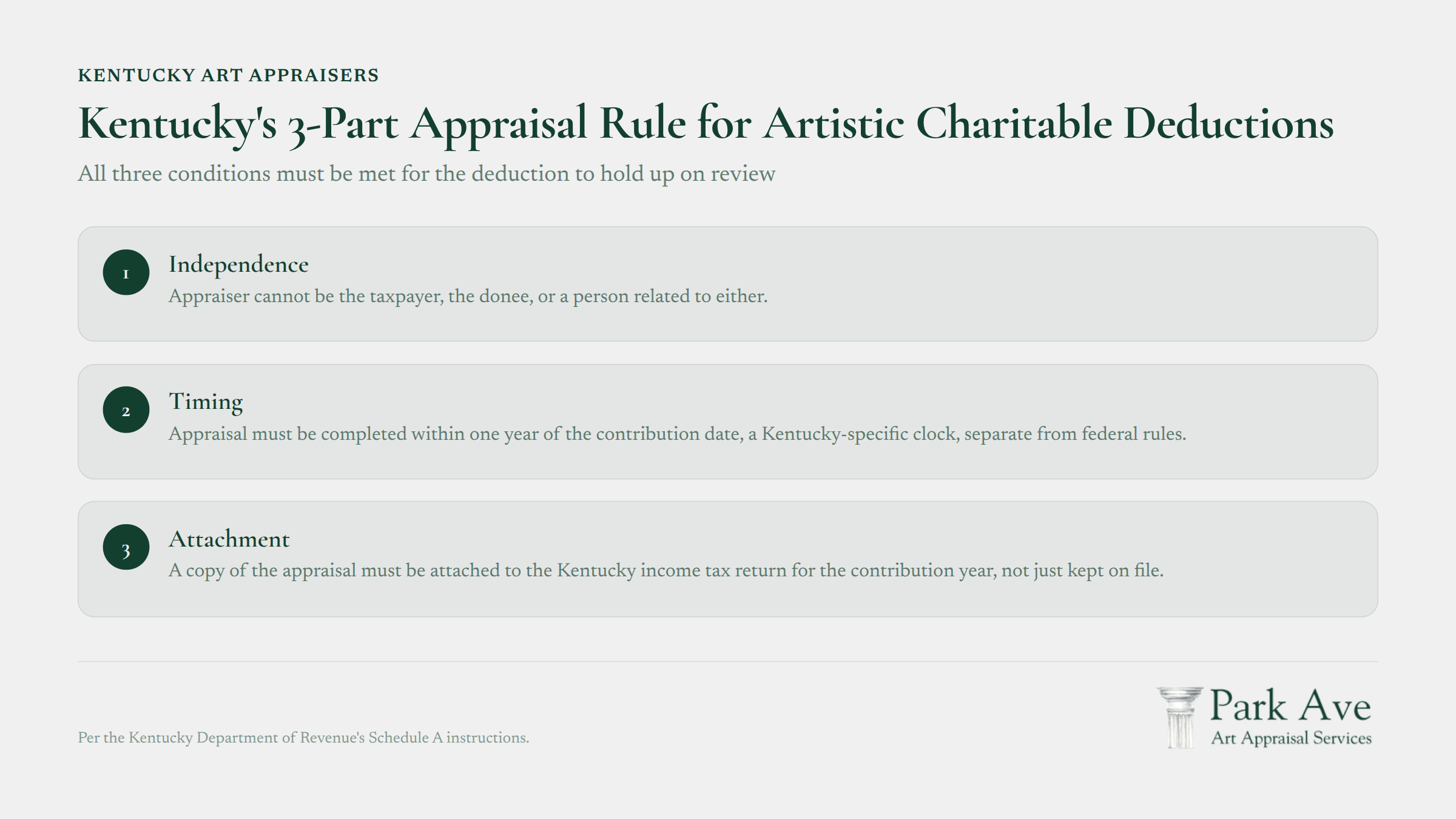
The Kentucky deduction is not self-executing. It requires a written appraisal of the property's fair market value, and that appraisal has to meet three conditions of its own:
- Independence. The appraiser cannot be the taxpayer, the donee, or a person related to either.
- Timing. The appraisal must be completed within one year of the contribution date.
- Attachment. A copy of the appraisal must be attached to the Kentucky income tax return for the year the contribution was made.
That one-year timing window is a Kentucky-specific rule, and it runs on its own clock. It is not the same as the federal qualified appraisal timing rule described below, which measures backward from the contribution and forward to the filing deadline. An artist claiming this deduction needs documentation built for both windows at once, not a single appraisal that happens to satisfy one of them by accident.
Watch out: Kentucky's Schedule A instructions direct taxpayers to attach the appraisal to the return itself, not simply retain it in their files. Filing without it is one of the more common reasons this deduction gets flagged or denied on review, per the Kentucky Department of Revenue's Schedule A instructions.pdf).
For artwork appraisals generally, our fees are quoted as a fixed amount once we understand the scope: a standard artwork appraisal starts at $295, an IRS-qualified appraisal suitable for tax filings starts at $395, and most engagements land between $595 and $2,000 depending on the number of pieces and the depth of research required. You can see how appraisal cost is scoped in more detail before requesting one.
How Much Can You Actually Deduct? The Artistic AGI Cap
The deduction is limited each year to the taxpayer's artistic adjusted gross income: the portion of Kentucky adjusted gross income attributable to income from creating the donated type of property, or from teaching, lecturing, or performing related to it. Appraised value sets the ceiling; artistic AGI sets the actual limit.
Example: A Kentucky sculptor donates a piece to a qualifying museum. The appraisal comes back at $100,000. That same year, the sculptor's income from creating and exhibiting sculpture (their artistic adjusted gross income) totals $30,000. Even though the appraisal supports a $100,000 fair market value, the Kentucky deduction for that tax year is capped at $30,000.
This cap is why the appraisal and the tax planning conversation need to happen together. An artist with a strong appraisal but a lean year of artistic income may want to talk to a CPA about timing the donation, or about whether any unused value carries forward, before finalizing the gift.
Kentucky's Deduction vs. the Federal Rule for Self-Created Art
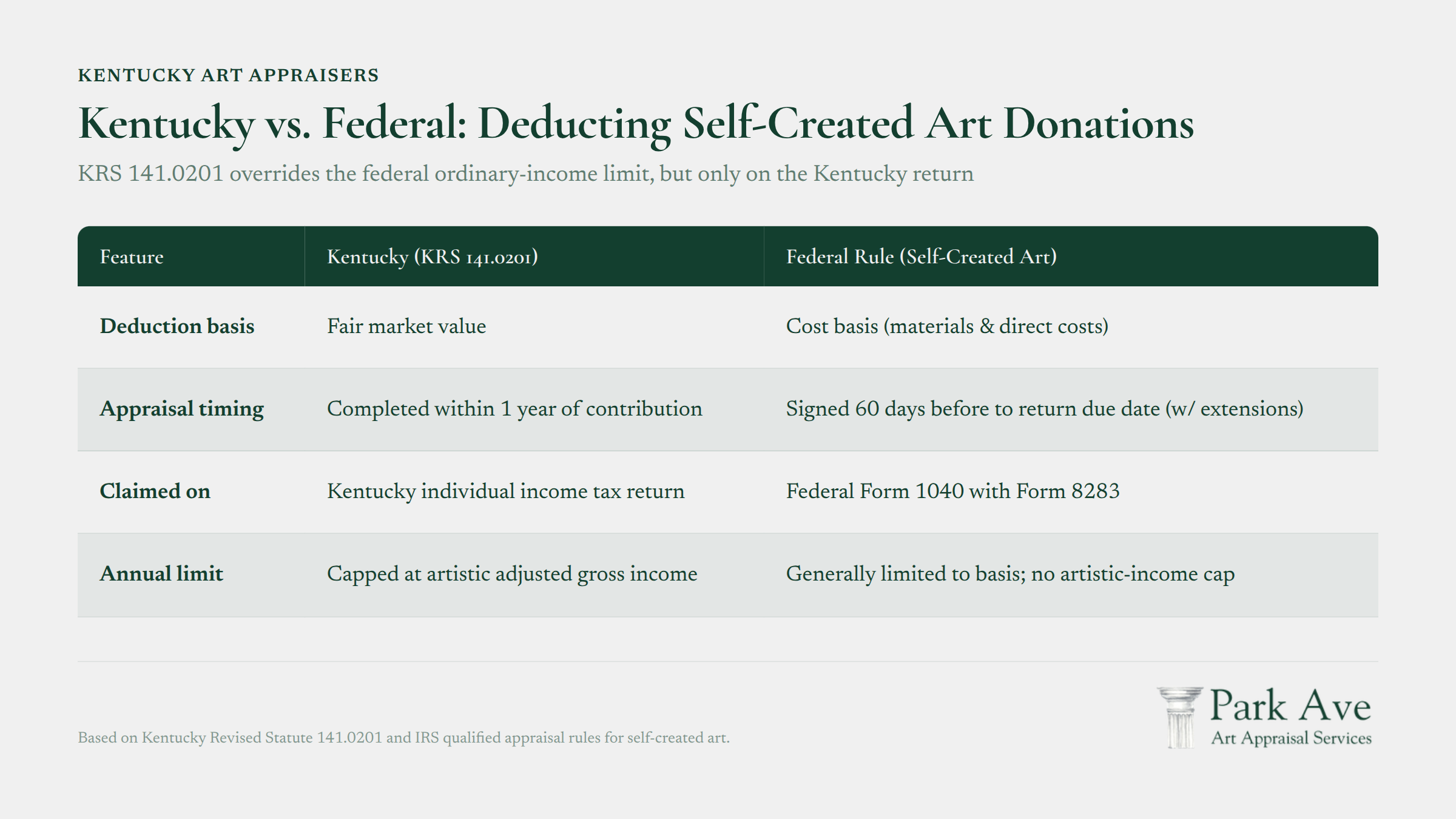
The biggest point of confusion is that Kentucky and federal law start from opposite premises for the same donated piece. Federally, the IRS treats self-created art as ordinary-income property, which limits the charitable deduction to the artist's cost basis, generally just materials and direct creation costs. Kentucky's statute exists specifically to override that outcome on the state return.
| Feature | Kentucky (KRS 141.0201) | Federal Rule for Self-Created Art |
|---|---|---|
| Deduction basis | Fair market value | Cost basis (materials and direct costs) |
| Appraisal timing | Completed within 1 year of contribution | Signed no earlier than 60 days before, no later than the return due date (with extensions) |
| Return it's claimed on | Kentucky individual income tax return | Federal Form 1040 with Form 8283 |
| Annual limit | Capped at artistic adjusted gross income | Generally limited to basis; no separate artistic-income cap |
| Documentation filed | Copy of appraisal attached to KY return | Form 8283 Section B; full appraisal attached if the art deduction is $20,000 or more |
The two processes run in parallel, not in sequence. A Kentucky artist still completes the federal Form 8283 process for federal purposes, following the timing and signature requirements described in the federal qualified appraisal rules, while separately satisfying Kentucky's one-year appraisal window and attachment requirement for the state deduction. One appraisal engagement can often be scoped to produce documentation that supports both, but the appraiser needs to know from the outset that both filings are in play.
Filing the Deduction on Your Kentucky Return
The artistic charitable contributions deduction is reported on Kentucky Schedule A, which accompanies Form 740 for residents or Form 740-NP for nonresidents and part-year residents. The Department's instructions specifically call for a copy of the appraisal to be enclosed with the return for the year of the contribution, not merely kept in the taxpayer's records for later production if audited.
Because the deduction requires an independent appraiser and a use statement from the donee, it helps to line up both before the contribution closes rather than scrambling afterward. A personal property appraisal prepared with this statute in mind will document the fair market value, note the one-year completion window, and format the report so it can sit alongside the federal Form 8283 paperwork without contradiction.
Getting the Documentation Right the First Time
Kentucky's artistic charitable contributions deduction rewards artists who plan ahead: know your artistic adjusted gross income before you donate, confirm the donee's exempt purpose and its willingness to sign a use statement, and get the appraisal completed inside the one-year window with enough detail to also stand up under federal Form 8283 review. Our appraisers hold credentials with organizations such as the ASA, ISA, and AAA, and prepare reports in accordance with USPAP so the valuation holds up whether it's reviewed by the Kentucky Department of Revenue, the IRS, or both.
This article is provided for general informational purposes only and does not constitute legal, tax, or financial advice. Readers should consult a qualified attorney or CPA regarding their specific circumstances.