
Blog
How Kentucky Probate Law Sets the Value Date for an Art Appraisal in Probate
Kentucky probate law fixes the value of inherited artwork on the decedent's date of death, not on a later sale price or gallery asking price. Here's how the 90-day inventory deadline, the fair cash value standard, and federal estate tax rules determine what an art appraisal for probate in Kentucky must show.
When a painting, print, or sculpture passes through a Kentucky estate, the number that matters isn't what it sells for next year or what a gallery is asking for a similar piece today. It's the value on the exact date the owner died. Executors who don't understand this often end up with an appraisal dated to the wrong day, a document a court or the Department of Revenue can reject, or a number that doesn't hold up if the Department later asks questions. Our Kentucky art appraisal service prepares USPAP-compliant reports pegged to the correct legal valuation date for probate inventories, inheritance tax filings, and federal estate tax returns.
Where Kentucky Probate Cases for Inherited Artwork Are Handled
Routine estate administration in Kentucky, including the inventory of a decedent's personal property, is handled in District Court in the county where the decedent was domiciled at death, not Circuit Court. Circuit Court only becomes involved if the matter turns into a contested adversary proceeding, such as a will contest or a dispute over an asset's value.
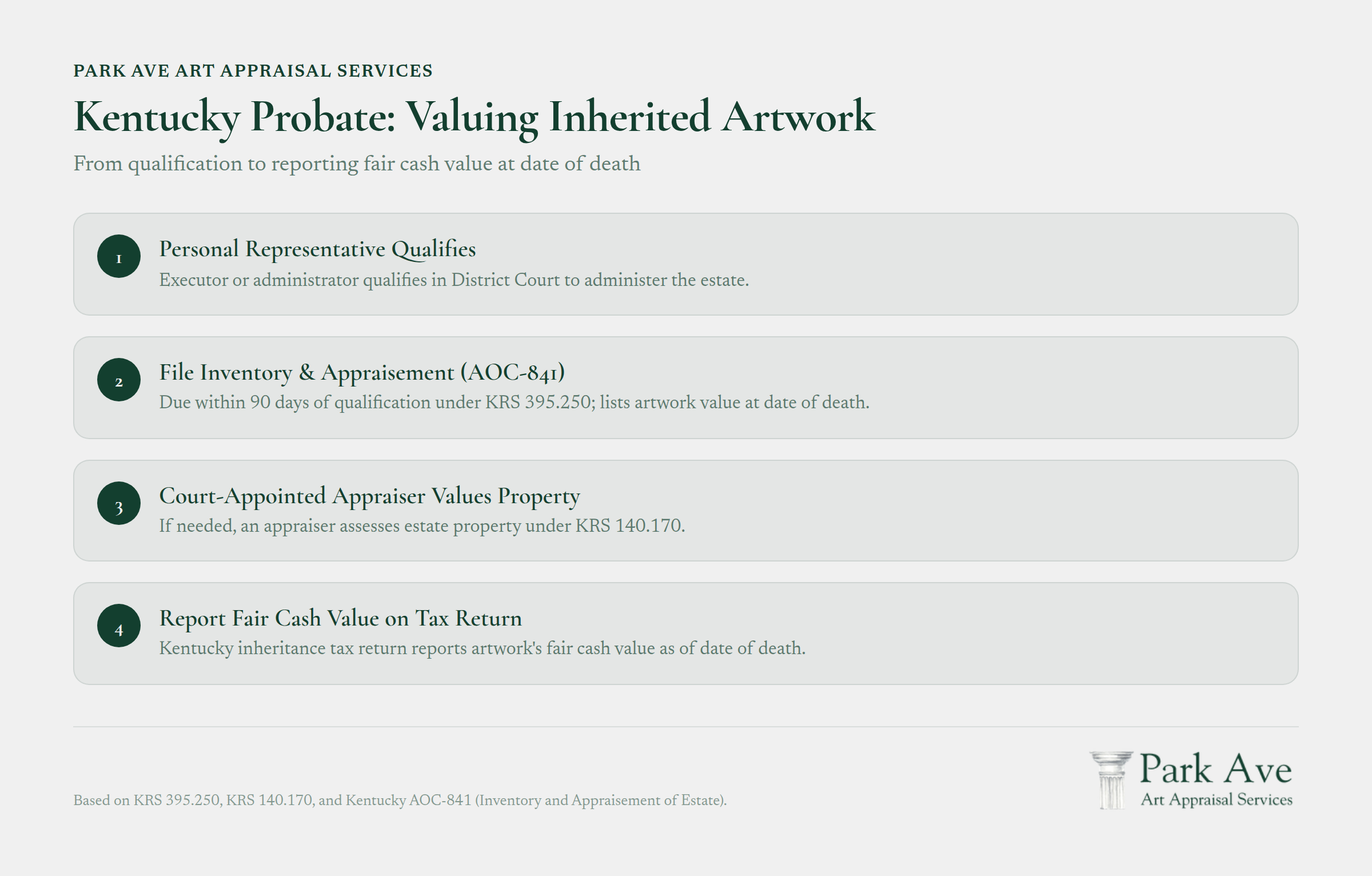
For most families, that means the personal representative (the executor or administrator) qualifies before the District Court clerk, receives letters testamentary or letters of administration, and then works through a defined set of filing deadlines. Kentucky's probate process follows this structure regardless of whether the estate includes a single inherited painting or an entire collection.
The 90-Day Deadline to Inventory and Appraise the Estate
Once a personal representative qualifies, Kentucky law requires them to file a complete inventory of the estate with the District Court. Under KRS 395.250, this inventory is due no later than 90 days after qualification, a window that was recently extended from a shorter 60-day period to give executors more time to gather documentation.
The court's own Inventory and Appraisement of Estate form (AOC-841) lists a specific category for personal property that includes furniture, artwork, and jewelry, with a required field for the value of each item at the date of death. That form makes the standard explicit: artwork isn't estimated at whatever it might fetch someday, it's valued as of the day the owner died.
Watch out: Missing the 90-day window doesn't just risk a late filing. It also compresses the time available to get a qualified appraiser in front of the artwork, gather comparable sales data, and produce a defensible report before the deadline arrives.
When Kentucky's Estate Settlement Shortcut Applies to Small Estates
Kentucky does allow a simplified path called dispensing with administration, but it isn't a flat-dollar small estate threshold the way some states use. Under KRS 395.455, this shortcut is available when the value of the personal property that would pass to a surviving spouse or children under the personal property exemption in KRS 391.030 equals or exceeds the value of the distributable estate. That exemption currently stands at $30,000 for deaths occurring on or after July 15, 2020.
In plain terms: if the artwork and other personal property in the estate are modest enough that the surviving spouse or children's exemption effectively absorbs the whole estate, formal administration (and the full inventory process) may not be required. Estates with material artwork, art collections, or pieces of uncertain value typically exceed this threshold and go through the standard inventory and appraisement process described above.
How the Date of Death Sets Fair Market Value for Estate Tax
For federal estate tax purposes, fair market value is set as of the date of death by default. The estate can elect an alternate valuation date six months after death under federal estate tax law, but only if that election lowers both the gross estate value and the estate tax owed, and only for property the estate still holds. Any asset sold or distributed within those six months is valued as of the date it was sold or distributed instead, not the six-month mark itself.
Kentucky's own inheritance tax follows a similar date-of-death principle, without the federal alternate valuation option. The Kentucky Department of Revenue's guidance states the rule plainly:
"Most of the time all real and personal property must be reported at its fair cash value on the date of decedent's death." - Kentucky Department of Revenue
Kentucky does carve out one narrow exception, allowing certain real estate passing to a son-in-law or daughter-in-law to be valued at agricultural or horticultural use instead of fair cash value. That exception applies only to specific real estate transfers. Inherited artwork always uses the standard date-of-death fair cash value rule, with no alternate date available.
Why a Gallery Asking Price Isn't Fair Market Value
Fair market value is a legal term with a specific meaning: the price a willing buyer would pay a willing seller in an arm's-length transaction, with neither party under compulsion to act and both having reasonable knowledge of the relevant facts. A gallery's listed asking price, an online marketplace estimate, or an insurance replacement figure doesn't meet that definition. Those numbers reflect what a seller hopes to get, not what a buyer has actually agreed to pay.
This distinction matters even more when an estate holds multiple works by the same artist or a sizable collection. In one well-known estate case involving hundreds of works of art collectively worth tens of millions of dollars, the court rejected both the estate's and the government's appraisals as unreliable and instead segmented the collection by quality, uniqueness, and salability, because not every piece in a large body of work could realistically sell at its full individual value within a short window. The lesson holds at any scale: a defensible art appraisal accounts for how, and how quickly, a given piece could actually reach the market, not just a catalog price for a comparable work.
Pro tip: If the artwork was recently insured, don't substitute the insurance appraisal for a probate appraisal. Insurance values are typically replacement cost figures designed to cover a total loss, and they run higher than fair market value by design.
Worked Example: Date-of-Death Value vs a Later Sale Price
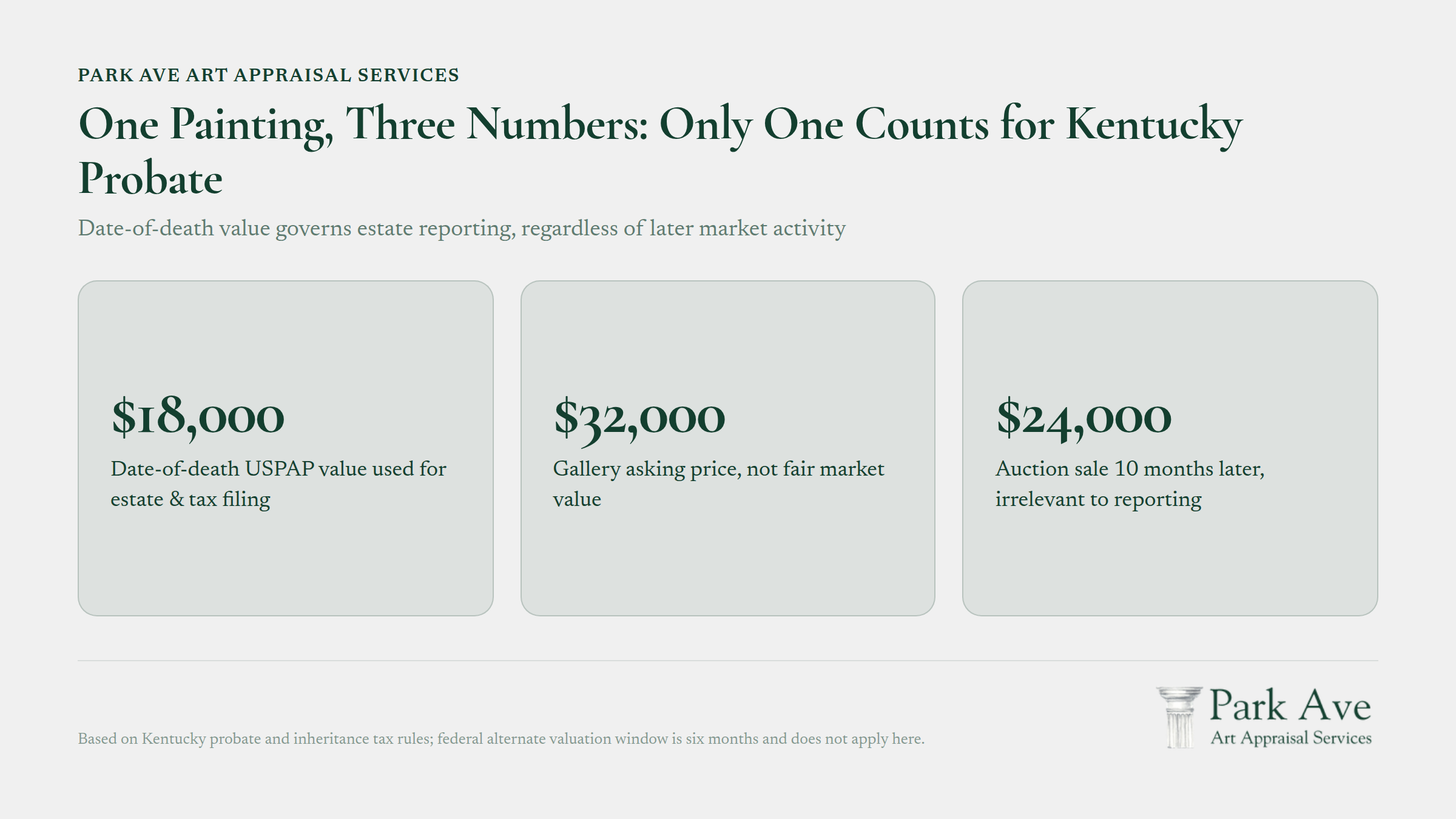
Example: A Kentucky decedent dies owning an oil landscape by a regional artist. The personal representative qualifies with the District Court 10 days later and commissions a USPAP-compliant appraisal dated to the exact date of death. Based on recent comparable auction results, the appraiser concludes a fair market value of $18,000 as of that date.
The painting doesn't sell right away. The personal representative consigns it to a gallery, which lists it at an asking price of $32,000, a figure with no bearing on the estate's tax reporting. Ten months later, the painting sells at auction for $24,000. Because the sale happened outside the six-month federal alternate valuation window, and because Kentucky's inheritance tax return doesn't offer an alternate valuation date for artwork, the estate reports the original $18,000 date-of-death value on both the probate inventory and the Kentucky inheritance tax return. The eventual $24,000 sale price is simply irrelevant to what the estate owes.
Why Executors Need a Dated, USPAP-Compliant Appraisal
An online value estimate or a dealer's verbal opinion won't hold up if the Department of Revenue audits the return or a beneficiary challenges the inventory. Kentucky's own extension guidance on estate settlement recommends that valuable collectibles, including artwork, antiques, and jewelry, be appraised by a qualified professional rather than valued informally, precisely because these categories lack the kind of public market pricing that applies to cash accounts or publicly traded securities.
A qualified appraisal for this purpose does three things an estimate can't:
- Dates the opinion of value to the correct legal valuation date, whether that's the date of death or, in the rare cases where it applies federally, the alternate valuation date.
- Documents the reasoning, including comparable sales, condition, authenticity, and market context, so the number can withstand scrutiny from the court, the Department of Revenue, or opposing counsel in a contested estate.
- Follows a recognized standard, prepared in accordance with USPAP (Uniform Standards of Professional Appraisal Practice) and typically performed by an appraiser holding credentials such as the ASA or ISA.
Our fine art appraisals for probate and estate purposes are quoted as a fixed fee once we understand the scope of the assignment: the number of pieces, whether the intended use requires IRS-qualified reporting, and how much research the artist or category requires. You can see how appraisal fees are typically scoped for artwork before you request a report, and it helps to know what not to say to an appraiser so your request keeps the date-of-death value independent and defensible. Engagements are quoted up front and never billed by the hour.
Key takeaway: The value that matters for a Kentucky probate estate is the value on the date the owner died, documented in a report dated to that day, not a gallery's asking price, an online estimate, or what the piece eventually sells for.
Getting the Valuation Date Right the First Time
Executors are usually managing a 90-day filing deadline, a grieving family, and a list of assets they've never had to value before. Artwork adds a layer most people aren't prepared for: knowing which date the appraisal has to reflect, and why a number from six months later doesn't count. Our team prepares USPAP-compliant art appraisals dated to the date of death (or the correct alternate valuation date when one applies) so the report holds up with the District Court, the Department of Revenue, and the IRS. If you're settling a Kentucky estate that includes artwork, you can request an art appraisal and we'll scope the assignment against your filing deadline.
This article is provided for general informational purposes only and does not constitute legal, tax, or financial advice. Readers should consult a qualified attorney or CPA regarding their specific circumstances.