
Blog
Art Appraisal for Divorce in Kentucky: How Equitable Distribution Splits Fine Art
Kentucky divides marital art under equitable distribution, not a 50/50 rule, so classification and valuation timing decide who keeps what. This guide walks through KRS 403.190, the marital versus nonmarital test for artwork, and why a neutral appraisal matters more than either spouse's estimate.
When a marriage ends in Kentucky, fine art rarely divides as cleanly as a bank account or a car. A painting bought on a honeymoon trip, an inherited landscape hanging in the study, a sculpture purchased with an inheritance check: each raises a different legal question before anyone even discusses price. Kentucky is an equitable distribution state, and courts apply that framework to art the same way they apply it to a retirement account or a house. Getting an art appraisal for divorce in Kentucky right starts with understanding that framework, because the appraisal answers exactly the questions the statute asks: what is this worth, as of when, and to whom did it belong in the first place.
Our appraisers at Kentucky Art Appraisers prepare USPAP-compliant valuations for exactly this purpose, giving attorneys, judges, and both spouses a defensible number to negotiate from rather than two competing guesses.
Kentucky Is an Equitable Distribution State, Not a Community Property State
Kentucky divides marital property under KRS 403.190, and the statute does not require a 50/50 split. It requires the court to divide marital property in "just proportions," which can mean one spouse keeps the art collection and pays an offsetting sum, or the pieces are sold and the proceeds divided, or specific works go to each spouse in a way that balances out overall.
Courts follow a three-step process for every asset in the marriage, including artwork:
- Classify each item as marital or nonmarital property.
- Restore nonmarital property to the spouse who owns it, outside the division.
- Divide the remaining marital property in just proportions, weighing each spouse's contribution, the marriage's duration, and each spouse's economic circumstances going forward.
That last step matters because Kentucky law is explicit that marital misconduct plays no role in the split. A spouse cannot argue for a larger share of the art collection because of an affair or a divorce filed on fault grounds. The division is about contribution and circumstance, not blame, a point Kentucky family law commentary consistently reinforces when explaining how equitable division actually works.
Is That Painting Marital or Nonmarital Property?
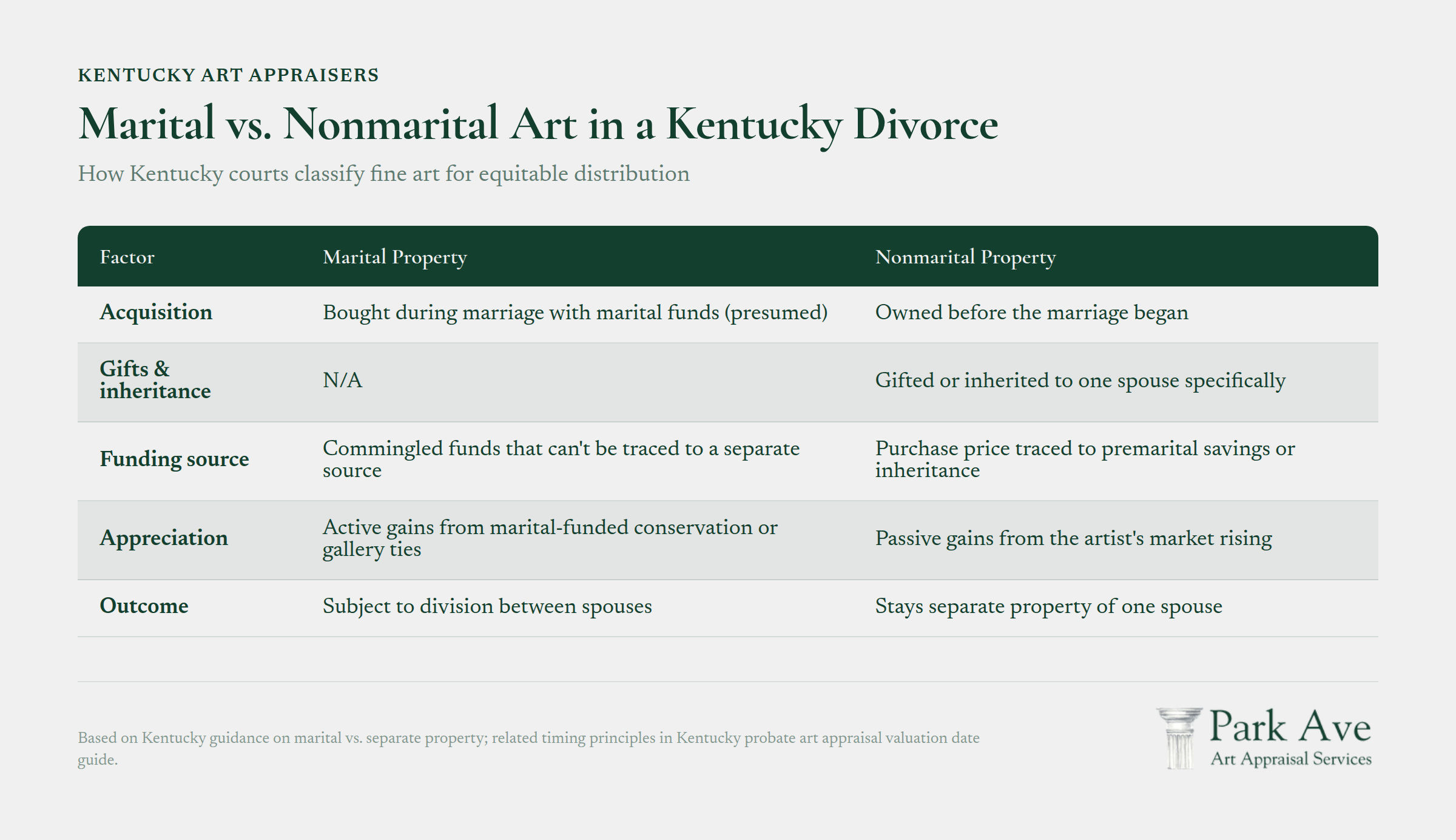
A painting acquired during the marriage with marital funds is presumed marital property, full stop, regardless of whose name is on the receipt or which spouse hung it in their home office. That presumption is the starting point for every classification dispute over art in a Kentucky divorce.
Several fact patterns move a piece out of the marital pool:
- Gift or inheritance to one spouse. A painting inherited from a parent, or given as a birthday gift to one spouse specifically, stays nonmarital even if the gift happened during the marriage.
- Purchase with traced nonmarital funds. If a spouse can trace the purchase price back to premarital savings, an inheritance, or another nonmarital source, the artwork remains separate property, according to Kentucky guidance on how marital and separate property are distinguished.
- Commingled funds that cannot be traced. When nonmarital and marital money mix in a way that makes the original source impossible to reconstruct, the artwork can lose its separate character entirely.
Appreciation adds another layer. If a premarital painting simply rises in value because the artist's market gets hot, that passive appreciation typically stays nonmarital, tied to the asset rather than to anything either spouse did. But if marital funds paid for conservation, authentication, reframing, or a gallery relationship that materially increased the piece's value, that active appreciation can become marital property subject to division, even though the underlying work itself remains separate. We cover a closely related question, how Kentucky law fixes the date used to value art in an estate, in our guide to Kentucky probate valuation dates, and many of the same tracing and timing principles carry over into divorce.
When Is the Painting Valued? Kentucky's Valuation Date Rules
KRS 403.190 does not name a specific date for valuing marital property, and that silence matters a great deal for art. Kentucky courts generally default to the date of trial or the date of the decree, on the theory that the most current value gives the fairest snapshot of what is actually being divided. But courts retain discretion to pick an earlier date, most often the date of separation, when an asset's value is volatile or when using a later date would let one spouse benefit from post-separation effort or market swings that had nothing to do with the marriage.
Kentucky courts have exercised that discretion in cases like Kaelin v. Meiners and Brown v. Brown, choosing a separation date rather than a trial date where an asset's value shifted meaningfully between the two points. Fine art is a textbook example of exactly that kind of volatile asset: an artist's market can move sharply on a single major auction result, a museum retrospective, or a change in critical reputation, all within the 12 to 24 months a divorce case commonly takes to resolve.
Watch out: If your attorney does not specify an effective date when ordering the appraisal, ask which date the court expects before the appraiser starts work. A report valued as of separation and a report valued as of trial can produce two very different numbers for the same painting, and redoing the analysis later costs time and money.
Why Courts Rely on an Independent, USPAP-Compliant Appraisal
Courts need a neutral appraisal because the statute asks judges to weigh contribution, nonmarital value, marriage duration, and each spouse's economic circumstances, and none of that analysis works if the starting value is contested or self-serving. A spouse who wants to keep the collection has every incentive to lowball its worth; a spouse negotiating for a buyout has every incentive to inflate it. Neither estimate gives the court, or opposing counsel, a number anyone can rely on. Both spouses are better served by understanding what not to say to an appraiser, since any attempt to steer the value undermines the independence the court is relying on.
An appraisal prepared in accordance with USPAP, published by The Appraisal Foundation, gives the court a defined standard of value (typically fair market value for divorce matters), a stated effective date, and documented market support such as comparable auction results or gallery sales. Attorneys handling contested property division routinely point to that kind of independent documentation as the difference between a settlement that holds up and one that gets challenged later, a pattern reflected in Kentucky family law commentary on how property gets divided in contested cases.
Pro tip: Ask your appraiser to identify the intended use as "marital dissolution proceedings" in the report itself. That single line signals to the court and to opposing counsel that the value was developed for exactly this purpose, not repurposed from an insurance schedule or an old estate inventory.
Worked Example: Splitting a Painting Bought Before the Marriage
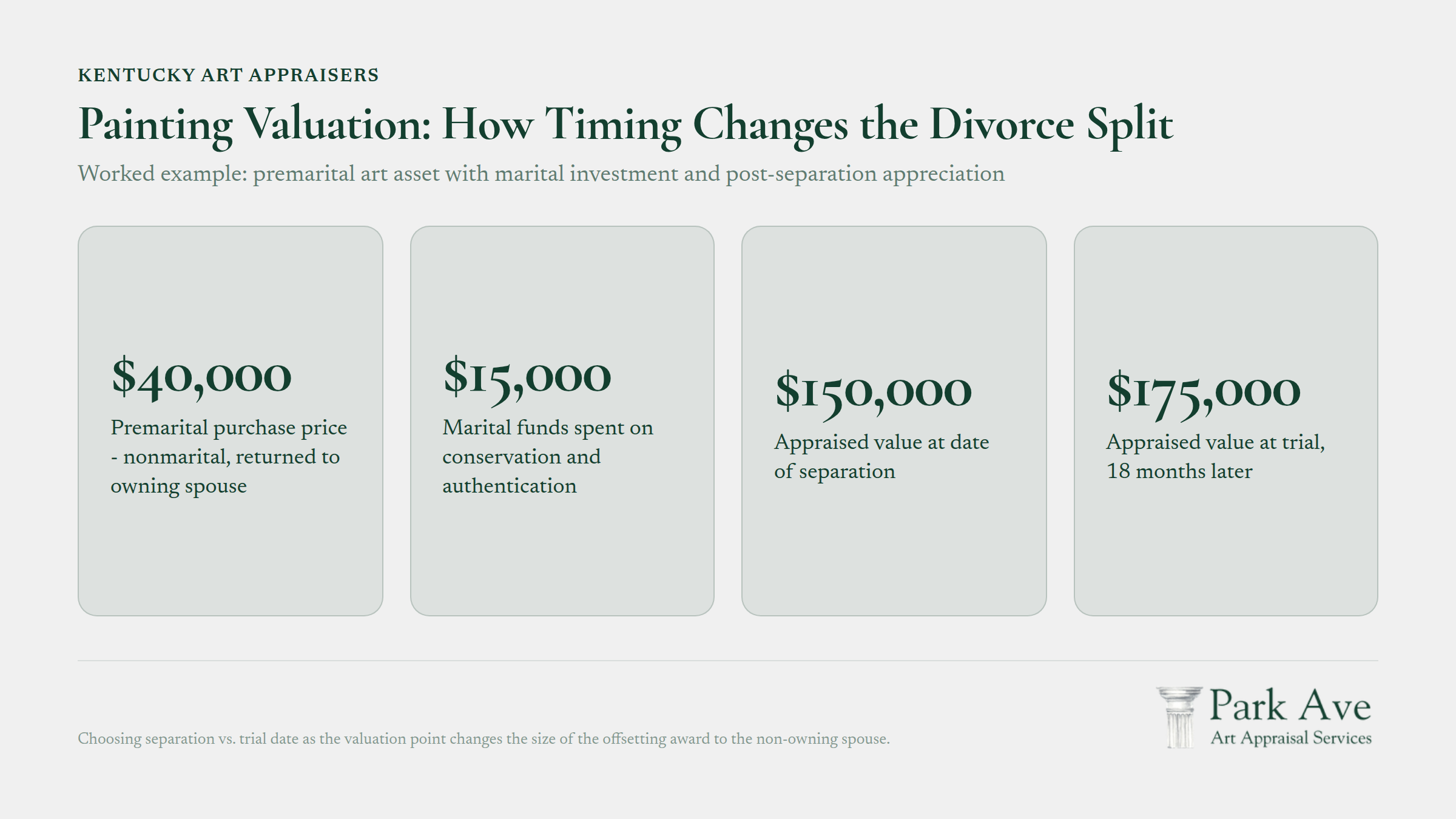
Suppose one spouse owned a painting worth $40,000 before the wedding. During the marriage, the couple spent $15,000 in marital funds on conservation work and a formal authentication that meaningfully raised the piece's market appeal. By the date of separation, the painting had appreciated to $150,000. By the time the case reached trial 18 months later, after a strong result for the artist at a major auction house, the appraised value had climbed to $175,000.
Here is how classification and timing interact in that scenario:
| Element | Treatment |
|---|---|
| $40,000 premarital purchase price | Nonmarital, restored to the original owner |
| $15,000 marital conservation and authentication spend | Marital contribution, factored into the division |
| Passive market appreciation to $150,000 | Largely tied to the nonmarital asset itself |
| Appreciation attributable to the marital investment | Marital property, subject to division |
| Value change from $150,000 to $175,000 after separation | Depends on which effective date the court selects |
If the court sets the effective date at separation, the owning spouse keeps the painting and the marital estate is credited with a share of the value tied to that $15,000 investment and its proportional appreciation, calculated against the $150,000 figure. If the court instead uses the trial date, the same math runs against $175,000, giving the non-owning spouse a larger offsetting award purely because of market timing that had nothing to do with either spouse's effort. That gap is exactly why the valuation date question, and the appraisal that supports it, carries real financial weight.
What This Means for a Kentucky Divorce Involving Art
A fair split starts with getting the classification and the date right, then letting a qualified appraiser do the math from there. Kentucky courts also retain broad authority to order the sale of marital property, including collectibles and art, when an equitable division cannot be achieved by simply awarding pieces to each spouse, a point Kentucky legal commentary on family court authority over asset sales in divorce has addressed directly. That possibility is one more reason a documented, defensible value matters well before the case reaches a courtroom.
If a painting, a collection, or a single valuable piece is part of a Kentucky divorce, get the appraisal scoped early, with the intended use and effective date spelled out in writing, so the number holds up whether the case settles at the negotiating table or in front of a judge. Request an art appraisal from our team to get that process started.
This article is provided for general informational purposes only and does not constitute legal, tax, or financial advice. Readers should consult a qualified attorney regarding their specific circumstances.