
Blog
Donate Art in Louisville and Lexington: Kentucky Museums, Charities, and the Appraisal the IRS Expects
Thinking of donating art to a Louisville or Lexington charity or museum? This local directory explains how Kentucky institutions receive gifts, and which appraisal documentation the IRS requires at $5,000, $20,000, and $50,000.
If you want to donate art to a Louisville or Lexington charity, two separate questions decide how it goes. The first is whether the institution will accept the work. The second is whether you can document its value well enough to claim a federal deduction.
The short answer: museums accept gifts selectively, they do not provide your appraisal, and any claimed deduction above $5,000 for an item or group of similar items needs a qualified appraisal from an independent appraiser. This guide walks through the Kentucky institutions that receive art, then the paperwork behind the deduction. For the broader statewide picture, see our guide to donating art to a Kentucky museum and the qualified appraisal the IRS requires.
Which Louisville and Lexington Institutions Receive Donated Art?
Several Kentucky museums, universities, and charities take gifts of art, but none of them guarantee acceptance. A museum's collections committee typically reviews title, provenance, condition, fit with its mission, and the long-term cost of storing and caring for the work. Contact the registrar, curator, or development office before you ship or deliver anything, and ask for the current collections policy and deed-of-gift form.
The entries below describe each institution in general terms only. Collecting areas and acquisition criteria change, so treat them as a starting point for your own inquiry.
Speed Art Museum (Louisville)
The Speed Art Museum publishes a donation page that covers planned gifts and bequests, which can include works of art. A planned gift of art is usually coordinated through the development office as well as the curatorial side. Ask early how a proposed gift would be reviewed.
Kentucky Museum of Art and Craft (Louisville)
KMAC is a contemporary art and craft institution, and its public donation page frames giving as support for the museum and its ongoing operations. Before assuming the museum wants an object, confirm whether it is seeking funds, works for the collection, or something else.
Frazier Kentucky History Museum (Louisville)
The Frazier publishes donation information, and its focus is Kentucky and regional history. A painting or object is a better candidate if you can document its tie to that story, such as a Kentucky subject, maker, or owner.
University of Louisville and the Hite Art Institute
The University of Louisville's planned giving office states that donors of tangible personal property above its stated threshold must obtain an appraisal from a qualified appraiser. The Hite Art Institute and the university's other collections may take art for teaching and study.
One caution: the UofL Bridwell Art Library says it cannot appraise collections for valuation or tax purposes. That statement covers library materials only, not every university gift, but it is a good reminder that the receiving party does not value your donation for you.
University of Kentucky Art Museum (Lexington)
University museums generally accept art selectively and weigh whether a work supports teaching, research, and the existing collection. Reach out to the museum's registrar or curatorial staff first and ask how gifts are reviewed.
Headley-Whitney Museum (Lexington)
The Headley-Whitney Museum publishes a donation page and is known for decorative arts and jewelry-related collections. Get written confirmation that your piece fits its scope before arranging delivery.
Charities That Resell Donated Art at Auction or Benefit Sales
Many nonprofits accept art specifically to sell it at a gala, silent auction, or consignment sale. That is a legitimate way to support a cause, and it can suit work a museum would decline. It also changes the tax treatment, as the related-use section below explains.
Acceptance Is Not Valuation
A museum's willingness to take a work says nothing about what the work is worth. Acceptance depends on mission, capacity, and stewardship. Your deduction depends on tax law and a documented fair market value, a point also made in legal commentary on charitable donations of art.
The institution is not your appraiser, and it is not allowed to be. The donor arranges the appraisal, and it must come from a qualified appraiser who is independent of both the donor and the receiving charity. A curator's informal estimate or a thank-you letter listing a value does not satisfy the rule.
Watch out: Do not ask the museum to name a value in the gift paperwork. The donee's signature on Form 8283 acknowledges receipt of the property. It does not signal agreement with your valuation.
What Documentation Does the IRS Require for Donated Art?
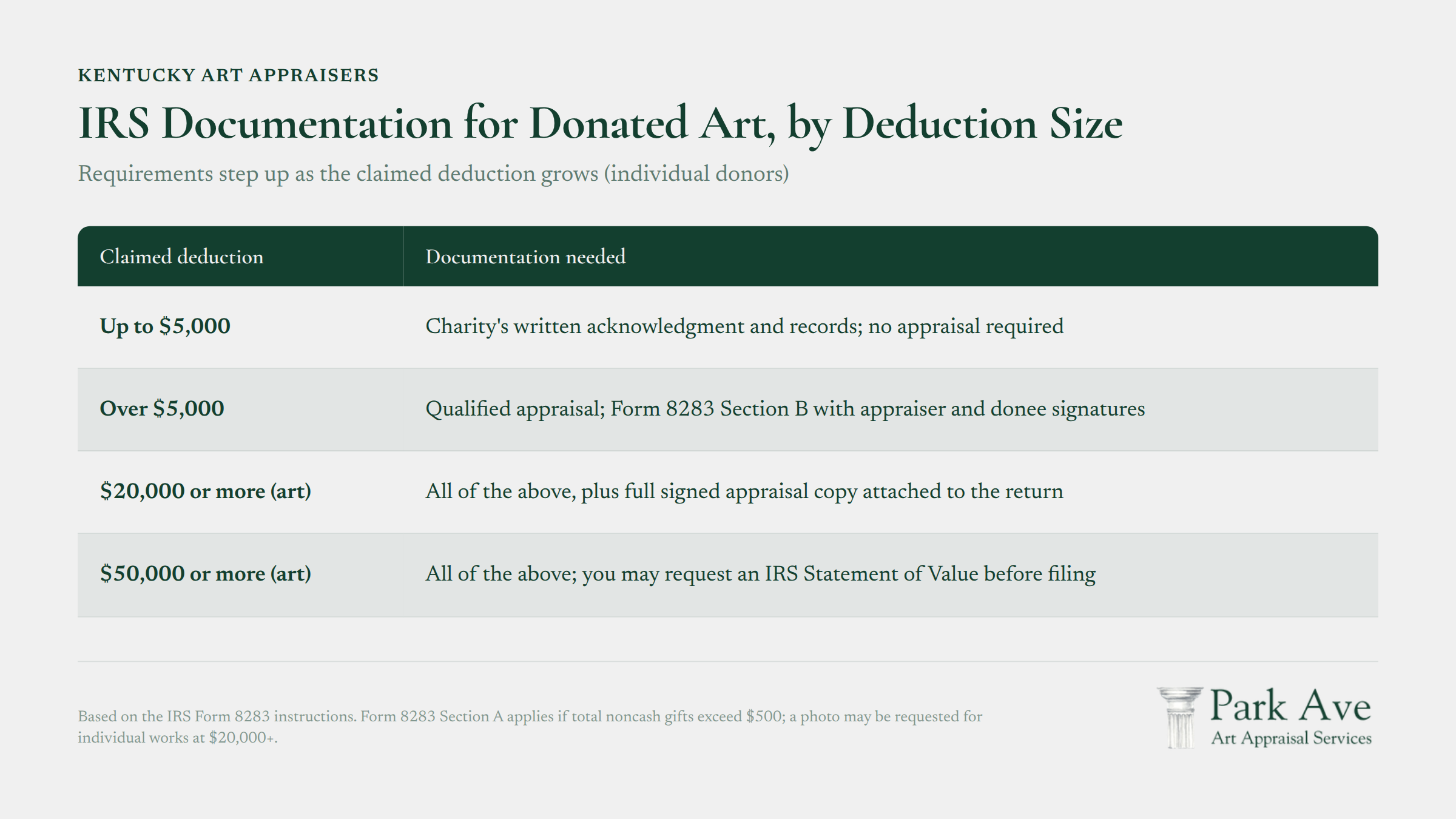
The documentation depends on the size of the claimed deduction. The Form 8283 instructions require a qualified appraisal and Section B when the claimed deduction for an item, or a group of similar items, exceeds $5,000. For art, the requirements step up again at $20,000, and a Statement of Value becomes available at $50,000.
The table below summarizes the main thresholds for individual donors:
| Claimed deduction | Documentation needed |
|---|---|
| Up to $5,000 | Written acknowledgment from the charity and reliable records; Form 8283 Section A if total noncash gifts exceed $500; no qualified appraisal required |
| Over $5,000 | Qualified appraisal by a qualified appraiser; Form 8283 Section B with the appraiser's signature and the donee's acknowledgment |
| $20,000 or more (art) | All of the above, plus a complete copy of the signed appraisal attached to the return; a photograph may be requested for individual works |
| $50,000 or more (art) | All of the above; you may request an IRS Statement of Value before filing |
Timing Rules for the Appraisal
IRS Publication 561 explains that the appraisal should be dated no earlier than 60 days before the contribution date and must be received by the due date of the return, including extensions. Publication 561 is also the source for the $20,000 attachment rule for art. Do not commission an appraisal years in advance and expect it to carry a later gift.
For valuable works, the IRS Art Appraisal Services program reviews art appraisals and issues Statements of Value for qualifying requests. A Statement of Value request must be made before you file the return that claims the deduction, so raise it with your CPA early.
The Related-Use Rule: Why Museum or Auction Matters
For tangible personal property such as a painting, the deduction can depend on how the charity uses the gift. If the charity's use is related to its exempt purpose (a museum displaying the work in its galleries), you can generally deduct fair market value. If the charity sells the work, the use is unrelated, and the deduction for appreciated property is generally limited to your cost basis. Adjusted gross income limits also apply, and IRS Publication 526 explains how they work.
Example: You donate a painting with an appraised fair market value of $30,000, which you bought years ago for $4,000. If a museum accepts it for display, your potential deduction is $30,000, subject to AGI limits. If a charity sells it at a benefit auction, your deduction is generally limited to your $4,000 basis, even if it sells for far more.
Two practical points follow. Ask the institution, in writing, how it intends to use the work. If a charity sells a donated item soon after receiving it, special reporting rules can apply, and your CPA should review them before you file.
Who Can Perform the Appraisal?
The IRS requires a qualified appraiser: someone with verifiable education and experience in valuing the type of property, who regularly performs appraisals for pay and is not barred from appearing before the IRS. Credentials from organizations such as the ASA, ISA, and AAA, along with USPAP training from The Appraisal Foundation, are the usual markers of that experience. Our appraisers hold credentials with leading organizations such as these, and our donation appraisals are prepared in accordance with USPAP and IRS requirements. For more on what to look for, read our guide to fine art appraiser credentials for IRS and court use.
The appraiser must also be independent. You cannot use the donor, the donee, a party to the transaction, or someone closely tied to them. Dealers who might buy the work later also pose an independence concern.
What the Appraisal Must Cover
A complete donation appraisal for a work of art should address the following:
- Identification: artist, title, medium, dimensions, date, and signatures or markings
- Authenticity: the appraiser's due diligence, such as catalogue raisonné checks and certificates of authenticity
- Condition and restoration: damage or restoration that affects value
- Valuation method: the approach used, with comparable sales supporting the conclusion
- Valuation date and fair market value: the date of the contribution and the concluded value
- Appraiser information: qualifications and identifying details
How Appraisal Fees Work
The fee is quoted as a fixed fee after we scope the assignment, never billed hourly, and it is paid by you, not the museum. What drives the number is scope: the number and complexity of works, the depth of research, the completeness of your records, and whether you need an IRS-qualified report. For a single work, our IRS-qualified artwork appraisals start at $395, and larger collections are scoped individually. Fine art appraisals are delivered online by default, so Kentucky donors can submit photographs and documentation from home.
A Sensible Order of Operations for Donors
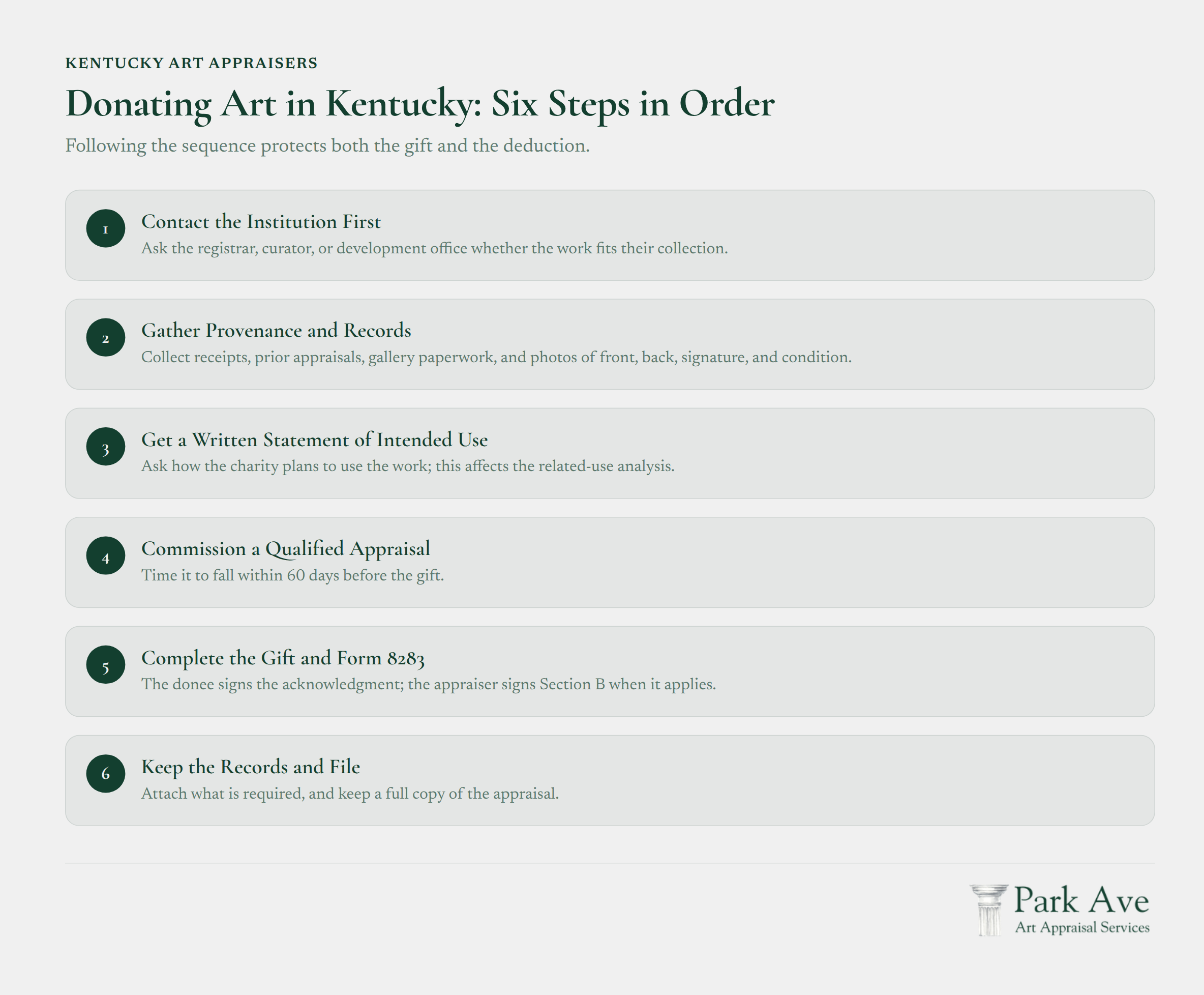
Following the steps in order protects both the gift and the deduction:
- Contact the Institution First
- Reach out to the registrar, curator, or development office and ask whether the work fits their collection.
- Gather Provenance and Records
- Collect receipts, prior appraisals, gallery paperwork, and photographs of front, back, signature, and condition.
- Get a Written Statement of Intended Use
- Ask how the charity plans to use the work, which affects the related-use analysis.
- Commission a Qualified Appraisal
- Time it to fall within 60 days before the gift.
- Complete the Gift and Form 8283
- The donee signs the acknowledgment, and the appraiser signs Section B when it applies.
- Keep the Records and File
- Attach what is required, and keep a full copy of the appraisal.
Start the Appraisal Before the Gift
Kentucky has real options for donated art, from Louisville and Lexington museums to university collections and charities that raise money at auction. Each decides on its own terms, so confirm interest first and then document value properly. If your deduction will exceed $5,000, start with a request for an art appraisal so the report is ready, correctly dated, and prepared in accordance with USPAP and IRS requirements.
This article is provided for general informational purposes only and does not constitute legal, tax, or financial advice. Readers should consult a qualified attorney or CPA regarding their specific circumstances.