
Blog
What Credentials Should a Kentucky Fine Art Appraiser Hold for IRS and Court Use
A qualified art appraiser Kentucky collectors can rely on needs different credentials depending on who reads the report: the IRS, a judge, or an insurer. This guide breaks down exactly what each audience expects and why the same appraiser's paperwork can look different for a donation, a divorce, and a policy.
Not every appraisal needs the same proof behind it. A fine art appraisal headed to the IRS with a charitable donation deduction faces a codified checklist. One headed into a Kentucky courtroom during a divorce or estate dispute faces a judge's discretionary judgment call. One headed to an insurer faces something looser still. Collectors who assume "credentialed appraiser" means the same thing in every context often discover the gap only after a report gets challenged.
Our fine art appraisal service prepares reports for all three audiences, and the credential profile we document shifts depending on the intended use. Here is what actually matters for each one.
Why Credentials Depend on Who's Asking
The short answer: the IRS applies a specific regulatory definition, Kentucky courts apply a flexible evidentiary standard, and insurers set their own internal documentation rules. None of the three is interchangeable with the others.
This matters because a collector preparing a donation to a Kentucky museum has a very different burden than a spouse preparing for equitable distribution in a divorce, even though both might hire the same appraiser for the same painting. Confusing the two standards is one of the most common mistakes we see, usually from collectors who assume a single designation covers every situation.
The IRS "Qualified Appraiser" Standard
For any charitable donation of art claimed above $5,000, the IRS requires a qualified appraisal prepared by a qualified appraiser, and that term has a specific regulatory meaning. Treasury Regulation 1.170A-13 and IRS Publication 561 lay out the requirements, and the Form 8283 instructions carry them forward into the filing itself.
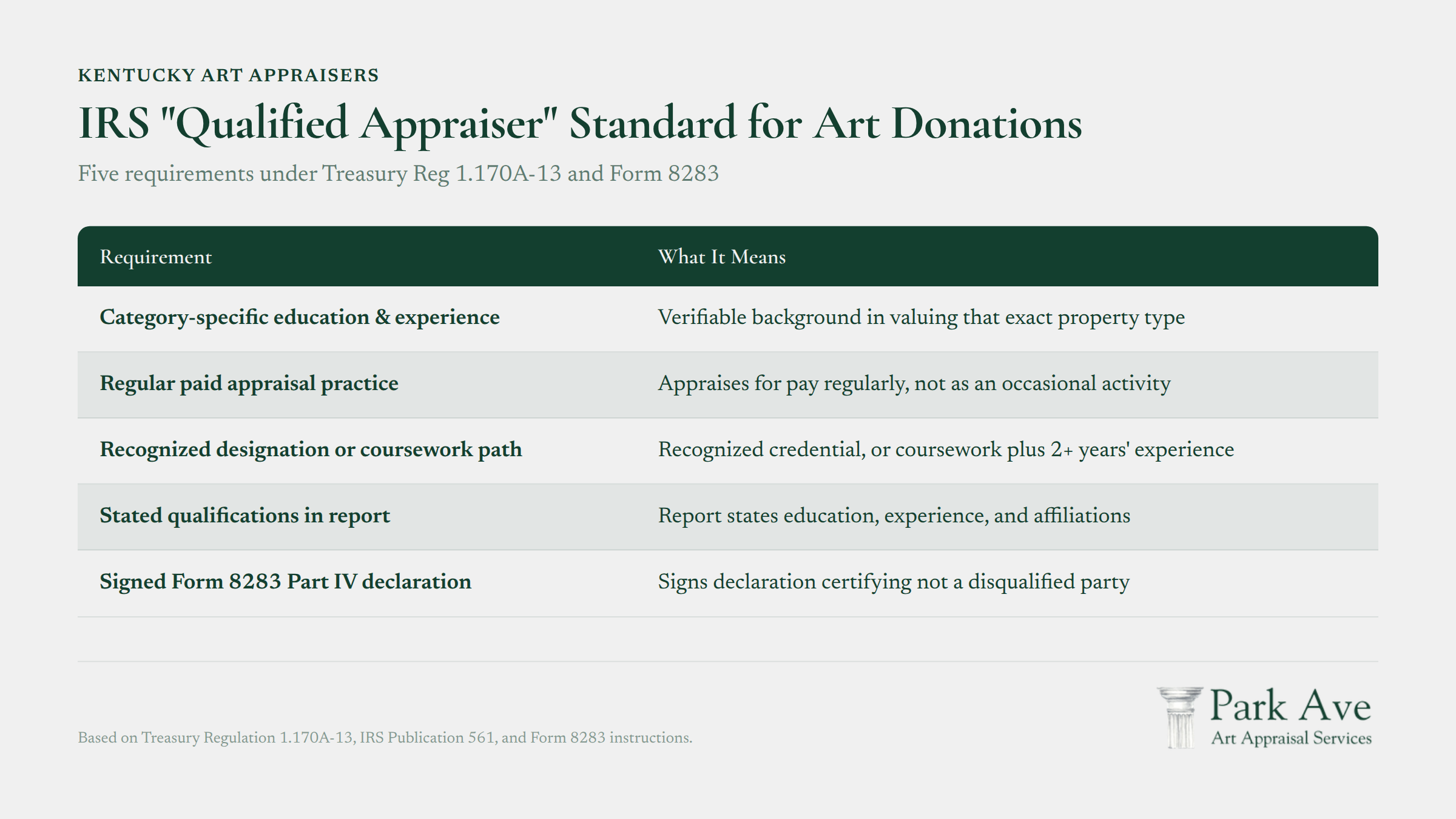
To qualify under this standard, an appraiser generally must meet the following conditions:
- Hold verifiable education and experience in valuing the specific category of property being appraised, not a general appraisal background.
- Regularly perform appraisals for pay, rather than appraising as an occasional side activity.
- Hold a recognized appraisal designation, or satisfy the IRS's alternate path of relevant coursework plus at least 2 years of hands-on valuation experience in that property type.
- State their qualifications in the report itself, describing the education, experience, and any professional affiliations that support their competence to value that specific category.
- Sign the appraiser declaration in Part IV of Form 8283, which also certifies the appraiser is not a disqualified party to the transaction.
A generalist credential does not automatically satisfy this standard. An appraiser qualified to value residential contents is not automatically qualified to value a 19th-century oil painting; the experience has to match the object. This is also why a fee tied to a percentage of the appraised value disqualifies an appraiser under IRS rules. Our fixed-fee engagements are structured for exactly this reason.
The stakes rise with value. Donated art claimed at $20,000 or more requires attaching the full signed appraisal to the return, and pieces at $50,000 or more can trigger referral to the IRS Art Appraisal Services unit and review by the Commissioner's Art Advisory Panel. If you're planning a gift to a Kentucky institution, our guide on donating art to a Kentucky museum walks through how these thresholds interact with the appraisal timeline.
ASA, ISA, and AAA: The Core Personal Property Designations
Three organizations anchor most credible fine art and personal property credentials in the United States: the American Society of Appraisers (ASA), the International Society of Appraisers (ISA), and the Appraisers Association of America (AAA). Each represents a structured path of coursework, testing, and ongoing education in personal property valuation, with specialization tracks that include fine art.
None of these designations, by itself, guarantees IRS acceptance or courtroom admission. What they establish is a documented, third-party-verified baseline: someone outside the appraiser's own practice has reviewed their training and testing. That record becomes part of the qualifications section the IRS wants to see, and part of the background a judge weighs when deciding whether an expert's opinion will help a jury or a bench trial.
Key takeaway: A recognized designation is strong supporting evidence of competence, but it supplements rather than replaces the specific experience requirement tied to the artwork's category, medium, and market.
USPAP: The Standard Underneath All of It
Regardless of audience, every credible fine art appraisal in the United States should be prepared in accordance with the Uniform Standards of Professional Appraisal Practice, commonly known as USPAP. These standards, developed and maintained by The Appraisal Foundation, govern how an appraiser identifies the property, states the valuation date and purpose, discloses assumptions, and documents the reasoning behind a value conclusion.
USPAP compliance is not optional window dressing. The IRS instructions for Form 8283 specifically require that a qualified appraisal be prepared consistent with the substance and principles of USPAP, and courts routinely treat USPAP conformance as evidence that an appraiser's methodology is reliable rather than improvised. It is the one standard that travels across all three use cases: IRS filing, courtroom testimony, and insurance documentation.
Kentucky Court Use: KRE 702's Discretionary Standard
Kentucky does not require a single mandatory license or designation before an art appraiser can testify as an expert. Instead, Kentucky Rule of Evidence 702 asks whether the witness is qualified by knowledge, skill, experience, training, or education to offer specialized testimony that will genuinely help the judge or jury. The decision is discretionary, made by the presiding judge on the facts of the case in front of them.
That discretion cuts both ways. A designation from the ASA, ISA, or AAA strengthens an appraiser's credibility, but it does not guarantee admission. Conversely, an appraiser without a formal designation may still qualify if their specialized experience, training, or education is substantial and directly relevant to the artwork at issue. Courts weigh the expert's familiarity with the specific artist, medium, or market, the reliability of the methodology used, and whether the opinion rests on sufficient facts and data rather than assumption.
This standard shows up most often in divorce and estate disputes, where one side's valuation is contested by the other. Our guide to art appraisal in Kentucky divorce cases covers how equitable distribution proceedings put appraiser credentials and methodology under direct scrutiny. Tax courts apply a similar logic when weighing conflicting valuations: one often-cited matter involving a donated sculpture shows a court rejecting a charitable deduction after finding the supporting appraisal's qualifications and reasoning insufficient. The lesson applies equally in Kentucky courtrooms: the credential matters less than whether the appraiser can defend the number under cross-examination.
Watch out: A designation without case-relevant experience will not save a weak report. Judges and the IRS alike look past the letters after an appraiser's name to the specific reasoning in the document.
Insurance Appraisals: A Lighter but Still Defensible Standard
Insurers want a defensible, standards-compliant valuation to support a coverage limit or a claim payout, but they rarely impose the codified requirements the IRS applies or the evidentiary scrutiny a court applies. Most carriers ask for a USPAP-compliant report, a clear replacement-value or fair-market-value conclusion depending on the policy, and documentation of the appraiser's relevant qualifications; they generally do not require a specific designation or a minimum number of years in the specific category.
That lighter bar does not mean credentials are irrelevant for insurance work. A poorly documented appraisal can still slow down a claim or draw a lowball counteroffer from an adjuster. Our guide comparing fair market value and replacement value for insurance explains how the right valuation basis protects a collector long before a loss ever happens.
Comparing the Three Standards
The table below summarizes how credential and documentation expectations differ across the three audiences a Kentucky fine art appraisal commonly serves.
| Audience | Governing Standard | Credential Expectation | Documentation Scrutiny |
|---|---|---|---|
| IRS (donations, estate, gift) | Treasury Reg. 1.170A-13, IRS Pub. 561 | Verifiable education and experience in the specific art category; designation or coursework plus 2+ years' experience; signed Form 8283 declaration | Codified; high-value items can trigger Art Advisory Panel review |
| Kentucky courts (divorce, estate disputes) | Kentucky Rule of Evidence 702 | No single mandatory license; judge evaluates knowledge, skill, experience, training, or education | Discretionary; depends on relevance and reliability of methodology |
| Insurers (coverage, claims) | Carrier-specific policy requirements | USPAP compliance generally expected; designation not usually mandatory | Lighter; focused on clear valuation basis and supporting documentation |
Choosing the Right Report for the Right Audience
The practical implication for Kentucky collectors is straightforward: tell your appraiser the intended use before the engagement starts, not after the report is finished. A donation appraisal destined for Form 8283 needs the IRS's specific qualifications language and a signed declaration. A valuation prepared for a contested divorce needs an appraiser ready to defend methodology under KRE 702's discretionary standard. A coverage appraisal needs a clear, USPAP-compliant conclusion that matches your policy's valuation basis.
Our team documents the appropriate qualifications and methodology for whichever audience your report is headed to, whether that's an IRS reviewer, a Kentucky judge, or an insurance adjuster. If you're preparing a donation, a divorce filing, an estate inventory, or a coverage renewal, request an art appraisal and let us know the intended use up front so the report is built for the right reader from the start.
This article is provided for general informational purposes only and does not constitute legal, tax, or financial advice. Readers should consult a qualified attorney or CPA regarding their specific circumstances.