
Blog
Fair Market Value vs. Replacement Value: What Your Kentucky Art Insurance Appraisal Needs
A Kentucky art insurance appraisal almost always needs to state replacement value, not fair market value, since insurers pay to replace a damaged or stolen piece through a dealer or gallery market. This guide shows Louisville collectors when each standard applies, from scheduling a painting with an insurer to donating a work to a museum or filing an estate tax return.
If you own art in Louisville and you're trying to figure out what number belongs on your insurance schedule, the IRS Form 8283, or an estate tax return, the honest answer is: it depends on which document you're filling out. Fair market value and replacement value are two different standards, built for two different jobs, and using the wrong one can leave you underinsured or get a tax return kicked back. Our Kentucky art appraisal team is asked about this mismatch constantly, usually right after a collector discovers their homeowners policy and their accountant want different numbers for the same painting.
What Fair Market Value Means for a Kentucky Collection
Fair market value (FMV) is the price a piece would bring between a willing buyer and a willing seller, with neither one under pressure to act and both having reasonable knowledge of the relevant facts. The IRS Publication 561 uses this exact framing for federal valuation purposes, and it's echoed by appraisal organizations when they explain how the standard is applied in practice, including a plain-language breakdown from the International Society of Appraisers.
FMV is anchored in the secondary market: auction results, private sale records, and comparable transactions for similar work by the same artist or school. It answers the question "what would this actually sell for right now," not "what would it cost to walk into a gallery and buy an equivalent piece today." That distinction matters more than most collectors expect, because gallery and dealer pricing typically runs higher than resale pricing once you account for retail margin.
What Replacement Value Means for an Art Insurance Policy
Replacement value is the amount needed to acquire a comparable piece, meaning similar age, quality, origin, appearance, provenance, and condition, through an appropriate retail or dealer channel within a reasonable time. Insurers covering fine art generally rely on this standard rather than FMV, and Chubb's guidance for collectors notes that a proper replacement value conclusion can include the retail purchase price along with taxes, commissions, framing, shipping, and related acquisition costs.
That last part trips people up. A replacement value appraisal isn't just a higher number pulled from a gallery price tag. It's a documented conclusion that reflects everything it would actually take to put an equivalent work back on your wall.
Watch out: A replacement value appraisal prepared for insurance is not automatically usable for a tax filing. If the report doesn't state fair market value as the type of value, under the willing buyer/willing seller standard, the IRS and most courts won't accept it as a substitute.
Fair Market Value vs. Replacement Value at a Glance
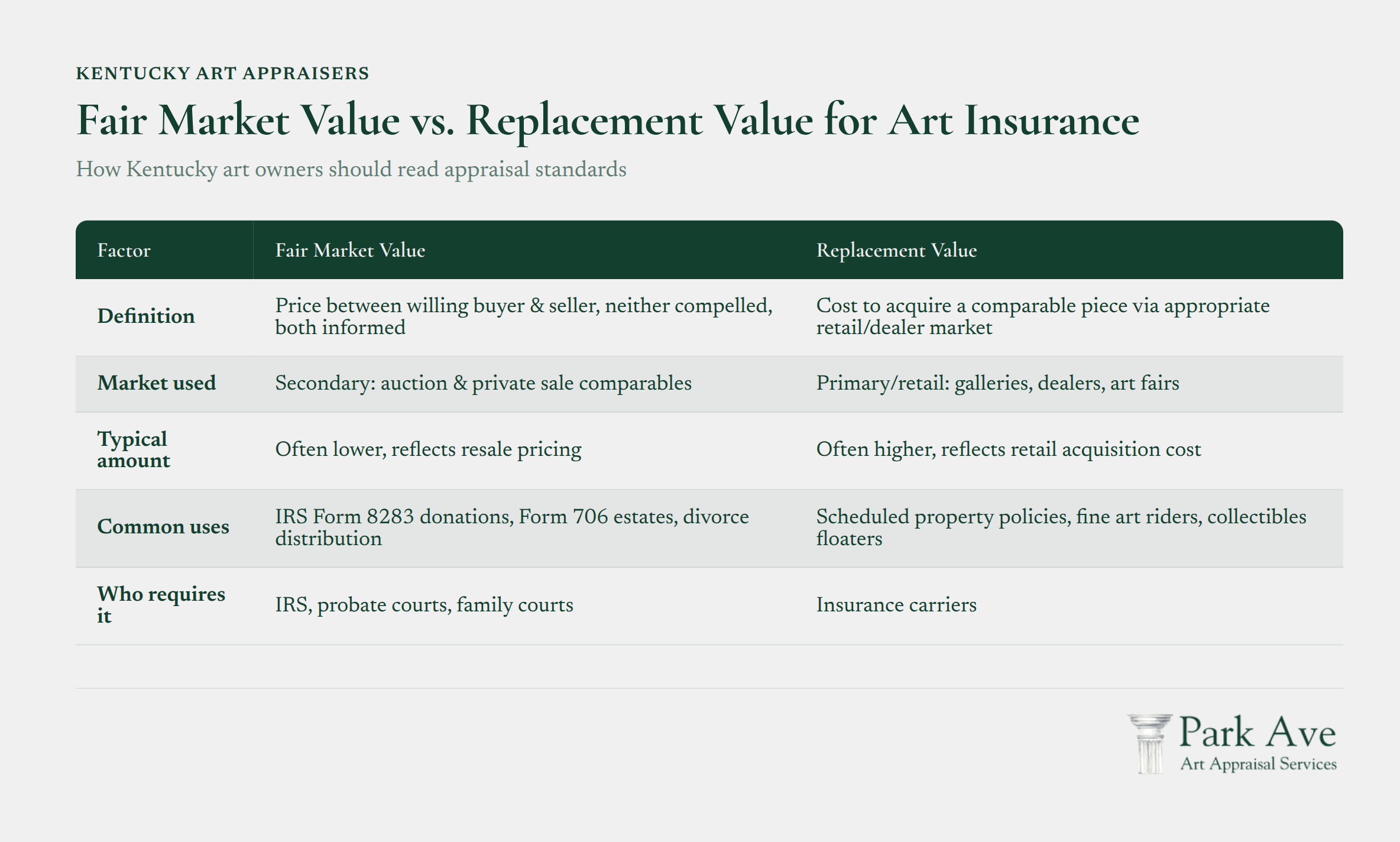
The table below summarizes how the two standards differ and where each one typically applies for a Kentucky art owner.
| Factor | Fair Market Value | Replacement Value |
|---|---|---|
| Definition | Price between a willing buyer and willing seller, neither compelled, both informed | Cost to acquire a comparable piece through an appropriate retail or dealer market |
| Market used | Secondary market: auction and private sale comparables | Primary/retail market: galleries, dealers, art fairs |
| Typical amount | Often lower, reflects resale pricing | Often higher, reflects retail acquisition cost |
| Common uses | IRS Form 8283 donations, Form 706 estate returns, equitable distribution in divorce | Scheduled personal property policies, fine art riders, collectibles floaters |
| Who requires it | IRS, probate courts, family courts | Insurance carriers |
When a Kentucky Insurer Requires Replacement Value
Example: A collector in the Highlands owns a small but well-documented group of regional landscape paintings, built up over two decades of visiting Kentucky galleries and estate sales. To schedule those pieces individually on a homeowners policy, the insurer typically asks for a current appraisal stated as replacement value, not fair market value, because that's the basis the policy actually pays claims on.
Most standard homeowners policies cap payouts on unscheduled art and collectibles at a modest dollar figure, which is why collections of any real size end up on a fine art rider or a personal articles floater. Those endorsements are built around replacement cost, replacement value, or an agreed value negotiated up front, and the appraisal supporting the schedule needs to match whichever basis the endorsement actually uses.
Pro tip: Read the valuation clause in your own policy before you order an appraisal. If the endorsement says "agreed value," the insurer has to honor the scheduled figure within the terms of the contract; if it says "replacement cost," there may be conditions around proof of purchase or an actual replacement before the full amount is paid.
When the IRS or a Kentucky Court Requires Fair Market Value
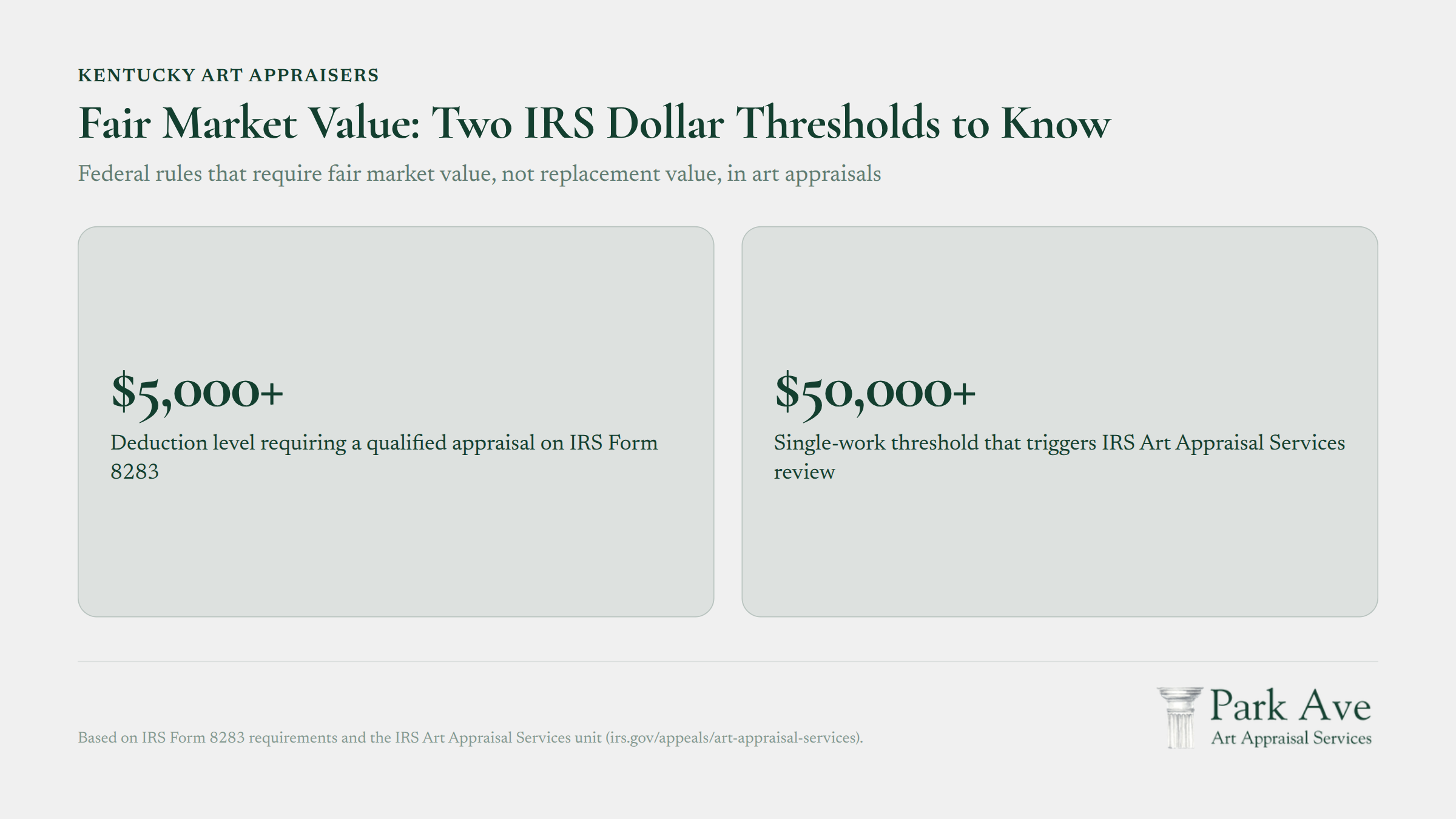
Example: A collector in Hurstbourne decides to donate a mid-century regional painting to a Louisville museum. Claiming a deduction above $5,000 on IRS Form 8283 requires a qualified appraisal, and that appraisal has to state fair market value, under the willing buyer/willing seller standard, with a valuation date tied to the donation. A replacement value figure from an insurance appraisal won't satisfy this requirement even if the painting is the same one scheduled on the owner's policy.
The stakes rise with the dollar amount. The IRS Art Appraisal Services unit typically reviews cases involving a single work claimed at $50,000 or more, pulling in specialists to evaluate the appraisal's reasoning and comparables. That referral threshold applies whether the artwork shows up on a charitable donation, a gift tax filing, or an estate tax return.
Fair market value also governs:
- Estate tax reporting (IRS Form 706): Art included in a decedent's estate is valued at fair market value as of the date of death (or an alternate valuation date), not at what it would cost to replace.
- Divorce and equitable distribution: Kentucky courts dividing marital property look at what the art would actually sell for between arm's-length parties, following our Kentucky art appraisal guide for divorce proceedings, not what it would cost to buy a comparable piece retail.
- Charitable deduction substantiation: A museum donation, like a gift to a regional institution, requires the qualified appraisal described in our guide to donating art in Kentucky.
Why One Collection Can Need Two Different Appraisals
Here's the part that surprises a lot of collectors: the same painting can need a fair market value appraisal and a replacement value appraisal within the same year, for two completely legitimate reasons. A piece insured on a fine art rider still needs its own FMV conclusion the moment it's donated, inherited, or divided in a settlement.
The Uniform Standards of Professional Appraisal Practice, published by The Appraisal Foundation, require an appraiser to identify the type of value being concluded and the intended use of the report before any analysis begins. That requirement exists precisely because the two standards aren't interchangeable, and a report written for one purpose can misstate value if it's stretched to cover the other.
Key takeaway: Order your appraisal around the document you need to produce, not around the asset itself. An insurance appraisal and a tax appraisal for the same painting are two separate engagements, even when the artwork, the appraiser, and the inspection date are identical.
What a Kentucky Art Appraisal Report Should State
A defensible report, whichever standard it uses, should document the following:
- Identification: artist, title, date, medium, dimensions, and edition information where applicable.
- Provenance: ownership history, exhibition record, publication history, and authenticity evidence.
- Condition: current physical condition and any conservation or restoration history.
- Market analysis: comparable auction results for FMV, or comparable dealer and gallery offerings for replacement value.
- Definition of value: the specific standard applied and the source of that definition.
- Effective date: the date the conclusion applies to, since art markets shift.
- Assumptions and limiting conditions: anything the appraiser relied on without independent verification.
Our appraisers hold credentials with organizations including the International Society of Appraisers (ISA), the American Society of Appraisers (ASA), and the Appraisers Association of America (AAA), and every report we prepare is built around USPAP's requirement to name the type of value and intended use up front, rather than leaving a client to guess whether a number is usable for the document in front of them.
Getting the Right Appraisal the First Time
The fastest way to end up with a report that doesn't work is to order a generic "art appraisal" without naming what it's for. Tell the appraiser whether you're insuring a collection, filing Form 8283 for a donation, reporting estate assets, or valuing marital property, and the report should come back built for that purpose from the first page. If you're not sure which standard applies to your situation, our team can walk through your policy language or filing requirement before the inspection even happens; you can request an art appraisal to get that conversation started.
This article is provided for general informational purposes only and does not constitute legal, tax, or financial advice. Readers should consult a qualified attorney or CPA regarding their specific circumstances.