
Blog
How Kentucky Inheritance Tax Applies to Inherited Artwork and Collections
Kentucky inheritance tax applies to artwork based on who inherits it, not on the size of the estate, and the beneficiary's class can mean the difference between owing nothing and owing 16 percent. This guide breaks down the exemptions, the appraisal requirements, and the planning moves that protect a collection's value for heirs.
Kentucky Still Taxes What Heirs Inherit, Even Without a State Estate Tax
Most states have dropped their inheritance tax over the past two decades, but Kentucky is one of the few that kept it. Kentucky has no separate state estate tax, but it does levy an inheritance tax on the right of a beneficiary to receive property from someone who died a Kentucky resident. That distinction matters for anyone settling an estate that includes fine art: the tax is not calculated against the estate as a whole, it is calculated against what each individual beneficiary receives.
Artwork, along with antiques and other collectibles, is treated as tangible personal property under Kentucky law, and it gets valued at fair market value on the date of death. If a collection is left to multiple people, or split between family members and non-relatives, each portion is taxed according to that specific beneficiary's relationship to the decedent. Getting an accurate, defensible valuation early, ideally through our art appraisal services, gives an estate the documentation it needs before returns are due, not after questions come up.
Beneficiary Class Determines the Tax Rate on Inherited Artwork
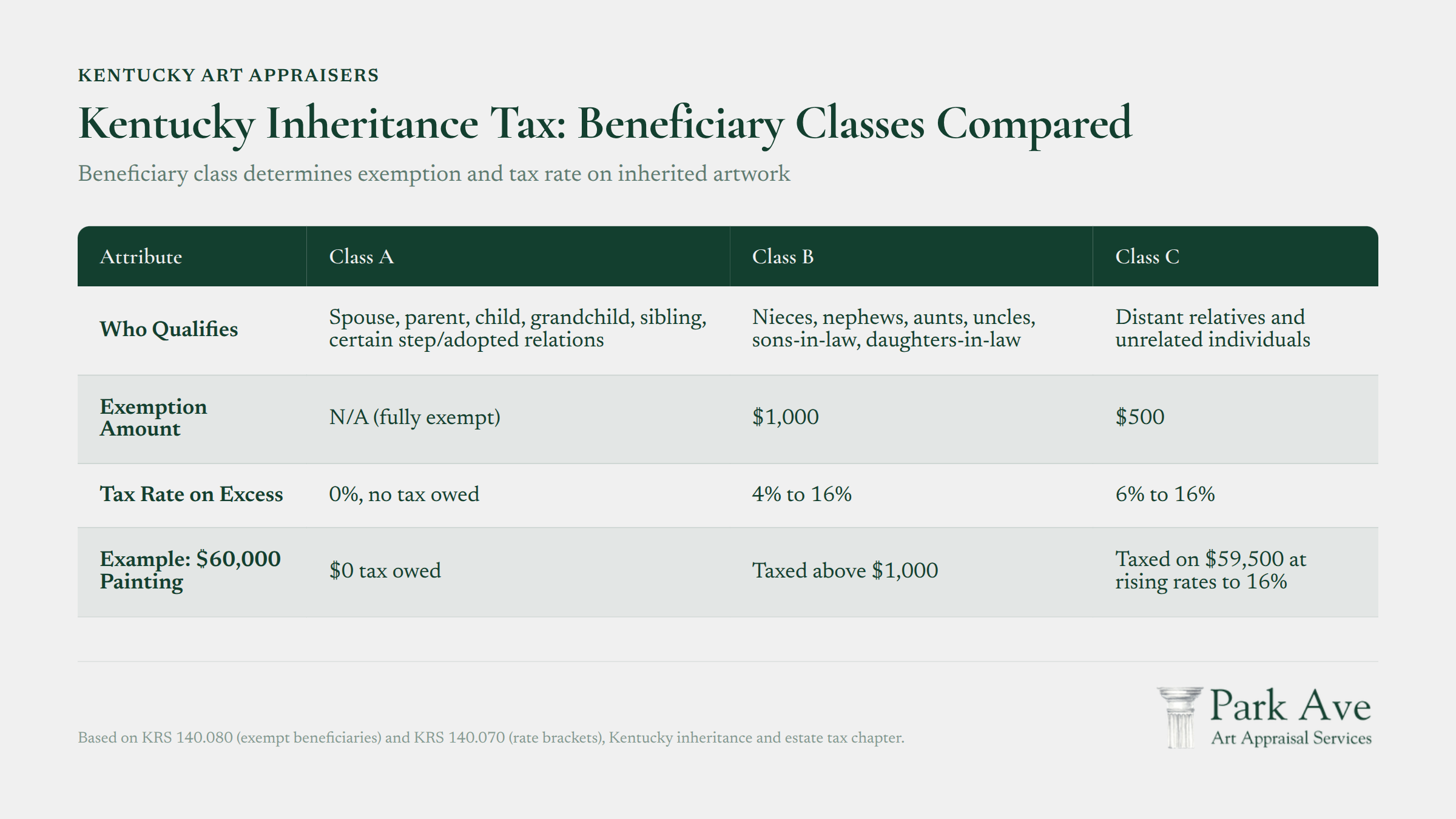
Kentucky sorts beneficiaries into three classes, and the class controls both the exemption amount and the tax rate applied to anything above it. This is the single biggest variable in how much tax a family will pay on an inherited art collection.
- Class A beneficiaries (spouse, parent, child, grandchild, sibling, and certain step or adopted relations) pay no Kentucky inheritance tax at all. An art collection passing to a surviving spouse or a child owes nothing regardless of its appraised value.
- Class B beneficiaries (nieces, nephews, aunts, uncles, sons-in-law, daughters-in-law) receive a $1,000 exemption, then pay tax at rates from 4% to 16% on the value above that.
- Class C beneficiaries (more distant relatives and unrelated individuals) receive only a $500 exemption, then pay tax at rates from 6% to 16% on everything above it.
These classes and their exemption structure come directly from KRS 140.080, the statute governing exempt beneficiaries and organizations under Kentucky's inheritance and estate tax chapter. The rate brackets themselves sit in the companion statute, KRS 140.070.
Example: A $60,000 painting left to a daughter (Class A) generates zero Kentucky inheritance tax. The same painting left to a cousin (Class C) is taxed on $59,500 of value (after the $500 exemption) at rates climbing to 16% as the taxable amount rises, producing a real tax bill in the thousands of dollars.
Why a Qualified Appraisal Serves Two Tax Filings at Once
An accurate appraisal of an inherited art collection does double duty because both the federal government and the Commonwealth of Kentucky require the same underlying number: fair market value at the date of death.
On the federal side, the IRS generally expects a qualified appraisal for any single item, or collection of similar items, valued above $3,000 when it is reported on Form 706, Schedule F of an estate tax return. See IRS.gov for current guidance on qualified appraisal requirements. Kentucky's own inheritance tax return likewise requires the fair market value of tangible personal property to be reported for each beneficiary's share, so a single, well-documented appraisal can support both filings rather than requiring separate valuations.
Our appraisers hold credentials with organizations such as the ISA, ASA, and AAA, and prepare reports built for exactly this kind of dual-purpose use: a defensible fair market value opinion that stands up whether it is reviewed by the IRS, a Kentucky Department of Revenue examiner, or a probate court.
Pro tip: If a collection is being divided among heirs in different beneficiary classes, ask the appraiser to itemize values by piece rather than reporting a single lump-sum figure for the whole collection. Per-item values are what actually get taxed once the pieces are assigned to specific people.
How the Federal Estate Tax Exemption Interacts with Kentucky's Rules
The federal estate tax exemption for 2025 sits at $13.99 million per person, which means the overwhelming majority of estates, including many that hold valuable art collections, owe no federal estate tax at all. Families sometimes assume that clearing this high federal bar means they are done with estate-related tax planning for the art collection.
Kentucky's inheritance tax does not work that way. There is no size-of-estate threshold at all; a $2 million estate and a $20 million estate are treated identically at the state level. What determines the tax is exclusively the beneficiary class receiving each asset. An estate can be well under the federal exemption and still generate a meaningful Kentucky inheritance tax bill if the art collection passes to nieces, nephews, or unrelated beneficiaries.
Watch out: Do not let a clean federal estate tax picture create false confidence about the Kentucky return. The two systems are calculated independently, and only one of them cares about total estate size.
Who Sets the Valuation Date, and Why It Isn't the Appraiser's Call
An appraiser determines value; the appraiser does not decide which date that value is measured on. On the federal side, an estate can elect an alternate valuation date six months after death instead of the date of death itself, but only if that election reduces both the gross estate and the resulting tax liability. That election is made by the estate's representative, not the appraiser, and it applies to the federal estate tax return only.
Kentucky's inheritance tax does not offer a parallel alternate date election. The Commonwealth values inherited property, including artwork, as of the date of death. That means an estate weighing a federal alternate valuation date needs an appraiser who can supply values at both dates if the art market has moved meaningfully in that window, since the Kentucky number will still be pinned to the date of death regardless of what happens on the federal filing. For a fuller walkthrough of how Kentucky probate proceedings set that date and what documentation the court expects, see our guide on how Kentucky probate law sets the value date for an art appraisal.
Filing Deadlines You Shouldn't Miss
Kentucky inheritance tax returns are generally due within 18 months of the date of death, though estates that file and pay within a shorter window can typically qualify for a discount, and interest begins accruing on unpaid balances after the deadline passes.
Because the appraisal underlies the entire return, waiting until close to the deadline to have an art collection valued is a common and avoidable source of delay. Auction houses, independent appraisers, and specialists in the relevant category can all have multi-week lead times, particularly for collections that need to be examined in person.
Splitting a Collection Among Heirs Changes the Total Tax Bill
How a collection is divided among heirs, not just its total value, drives the size of the Kentucky inheritance tax bill. This is the part of estate planning most families overlook until the return is already being prepared.
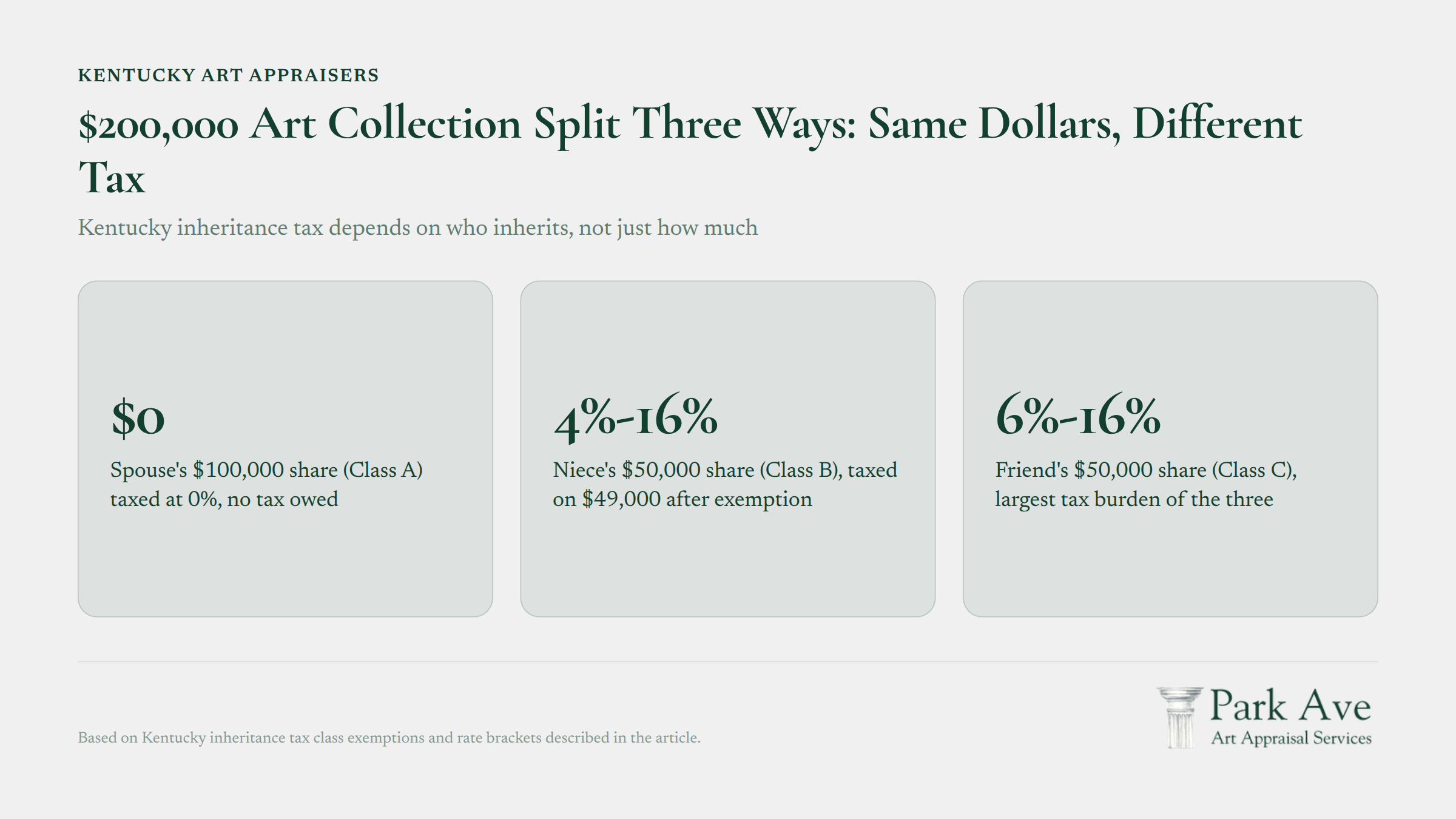
Consider a $200,000 art collection split three ways: half to a surviving spouse, a quarter to a niece, and a quarter to a family friend.
- The spouse's $100,000 share (Class A) is taxed at 0%, producing no tax.
- The niece's $50,000 share (Class B) is taxed on $49,000 after the $1,000 exemption, at rates between 4% and 16% depending on the bracket.
- The friend's $50,000 share (Class C) is taxed on $49,500 after the $500 exemption, at rates between 6% and 16%, producing the largest tax burden of the three shares despite receiving an identical dollar amount.
The same $50,000 slice of a collection can generate very different tax outcomes purely based on who receives it. Families that know this in advance sometimes restructure bequests, for example by directing specific high-value pieces toward Class A heirs and lower-value pieces toward more distant beneficiaries, to reduce the total tax paid without changing who ultimately benefits from the estate.
Get the Valuation Right Before the Return Is Due
An inherited art collection sits at the intersection of two tax systems that do not talk to each other: a federal system built around a very high exemption threshold, and a Kentucky system that taxes based on the identity of the beneficiary rather than the size of the estate. A single, well-documented fair market value appraisal at the date of death is the one piece of paperwork that supports both filings and gives every beneficiary class an accurate starting number.
Families working through a Kentucky estate that includes art, antiques, or other collectibles are better served by getting that appraisal early, before beneficiary designations are finalized, rather than after the fact when options for reducing the tax bill have already closed.
This article is provided for general informational purposes only and does not constitute legal, tax, or financial advice. Readers should consult a qualified attorney or CPA regarding their specific circumstances.